By Tracy Johnson – Colonic Training Skelmersdale
If you’ve been researching digestive support or colonic hydrotherapy training in the UK, you’ve probably come across both colonics and enemas.
They’re often spoken about as if they’re the same thing.
They’re not.
While both involve introducing water into the bowel, they differ significantly in depth, purpose, delivery, supervision, and professional standards.
Let’s break it down clearly.
What Is an Enema?
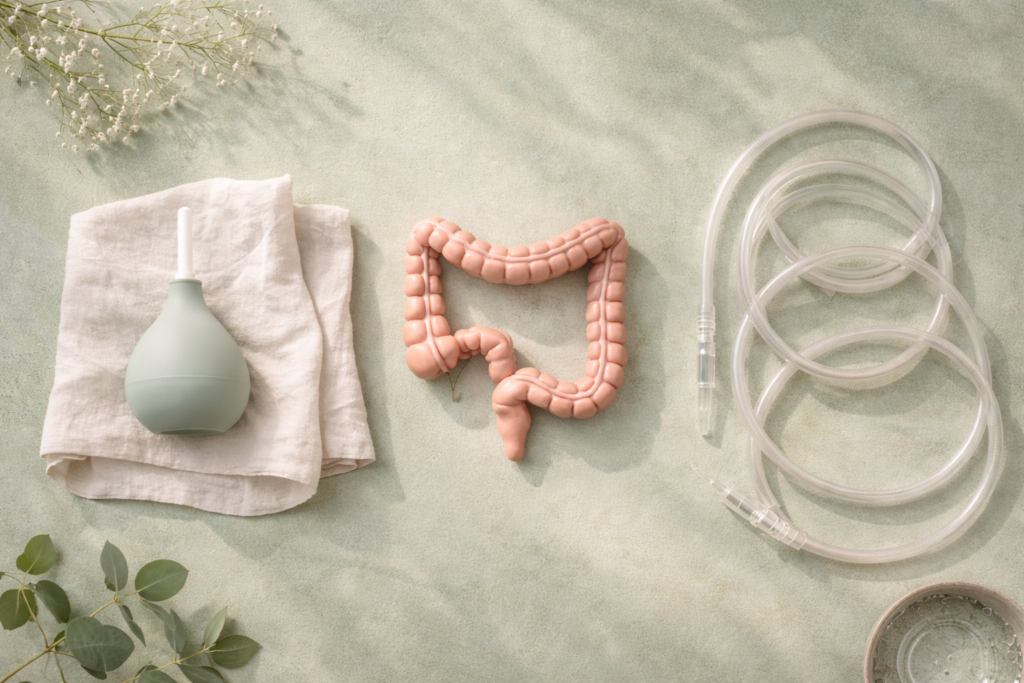
An enema is typically a self-administered or home-based method that introduces a small amount of liquid into the lower rectum only.
Enemas are commonly used:
- for short-term constipation relief
- before certain medical procedures
- as part of personal hygiene routines
They usually involve:
- a bulb or small bag
- a limited volume of fluid
- no professional supervision
Most enemas reach only the rectum and very lowest part of the colon.
They do not cleanse the full length of the bowel.
In medical settings, enemas may be prescribed for specific clinical reasons under healthcare guidance. At home, they are often used independently.
What Is Colonic Hydrotherapy?
Colonic hydrotherapy (also known as colonic irrigation or colon hydrotherapy) is a professionally delivered complementary therapy.
It involves gently introducing warm, filtered water into the colon using specialist equipment, with the process guided by a trained practitioner.
Key differences from enemas include:
- water reaches further into the colon
- the process is controlled and gradual
- waste is removed through a closed system
- the session is supervised by a trained practitioner
- client comfort, dignity, and safety are prioritised
Colonic hydrotherapy sessions also include:
- full client consultation
- screening for contraindications
- informed consent
- professional hygiene protocols
- clear scope-of-practice boundaries
It is offered as supportive self-care, not medical treatment.
The Main Differences at a Glance
Area of the bowel reached
- Enema: rectum / very lower colon
- Colonic hydrotherapy: potentially the full length of the colon
Supervision
- Enema: usually self-administered
- Colonic hydrotherapy: delivered by a trained practitioner
Equipment
- Enema: small bulb or bag
- Colonic hydrotherapy: professional-grade, closed-system equipment
Volume and flow
- Enema: small, one-off volume
- Colonic hydrotherapy: controlled, repeated gentle infusions
Safety framework
- Enema: personal responsibility
- Colonic hydrotherapy: professional consultation, contraindication screening, hygiene standards
Why This Matters for Clients
Many people assume an enema and a colonic are interchangeable.
They’re not.
Colonic hydrotherapy is:
- structured
- practitioner-led
- guided by professional boundaries
- delivered in a clinical-style environment
Clients are supported throughout the session, and practitioners are trained to recognise when treatment is not appropriate and when referral to a GP is needed.
This level of oversight simply does not exist with home enemas.
If someone has ongoing digestive symptoms, it’s also important to remember that complementary therapies are not a substitute for medical assessment. Persistent or severe symptoms should always be discussed with a healthcare professional such as the NHS.
Why This Matters for Students
If you’re researching colonic hydrotherapy training in the UK, this distinction is crucial.
Professional training covers far more than water delivery.
A proper course teaches:
- Anatomy and Physiology
- contraindications and red flags
- infection control
- client consent and documentation
- professional language
- ethical boundaries
- supervised clinical practice
You are not learning how to give an enema.
You are learning how to work responsibly with the colon, within scope, and with real people.
A Note on Safety and Expectations
Neither enemas nor colonic hydrotherapy should be approached casually.
Both involve the bowel.
Both require care.
Colonic hydrotherapy practitioners do not diagnose or treat disease. Sessions are offered as supportive self-care, and individual responses vary.
This is why professional education, transparency, and boundaries are essential.
Final Thoughts
Although enemas and colonic hydrotherapy may appear similar on the surface, they are fundamentally different in depth, supervision, and professional context.
An enema is a simple, lower-bowel intervention often carried out at home.
Colonic hydrotherapy is a structured, practitioner-led complementary therapy delivered within a framework of consultation, hygiene standards, and ethical care.
Understanding this difference helps clients make informed choices — and helps students appreciate why proper training matters.
At Colonic Training Skelmersdale, we teach that clarity builds trust.
And trust is the foundation of good practice.