There is a particular kind of professional frustration that healthcare workers rarely talk about openly. You went into nursing, midwifery, or holistic therapy because you wanted to genuinely help people. And you do — every day. But somewhere along the way, the system — the time pressures, the protocols, the appointment slots that never quite leave room for the whole person in front of you — starts to feel like it is working against that instinct rather than with it.
If that sounds familiar, you are not alone. And it is one of the most common things I hear from the nurses, midwives, and holistic therapists who come to me enquiring about colon hydrotherapy training.
What draws them is not just the prospect of doing something different. It is the prospect of doing something deeper — working with clients in a genuinely whole-person way, in their own time, on their own terms, with a level of clinical intimacy that most healthcare settings simply do not allow.
Colon hydrotherapy training is not the right move for everyone. But for the right person, it can be one of the most professionally and personally rewarding decisions they ever make. This article is written to give you an honest, thorough picture of what is involved — so you can make that decision clearly.
Why Gut Health Is One of the Fastest Growing Areas in Healthcare
The science of the gut microbiome has transformed in the past decade. What was once a relatively niche area of gastroenterology is now understood to be central to whole-body health — influencing immunity, mental health, hormonal regulation, metabolic function, skin health, and inflammatory conditions across the body.
Research published in leading medical journals has established links between gut microbiome diversity and conditions ranging from anxiety and depression to autoimmune disease and obesity. The gut-brain axis — the bidirectional communication pathway between the digestive system and the central nervous system — is now one of the most actively researched areas in medicine.
Public awareness has followed. More people than ever are actively seeking professional support for bloating, constipation, IBS, digestive discomfort, and gut-related fatigue. GP waiting times are long. Gastroenterology referrals longer still. The space for qualified, credible gut health practitioners to support this growing demand has never been larger.
Colon hydrotherapy sits within this landscape as a clinically grounded, professionally regulated treatment that addresses the large intestine directly — supporting gut motility, reducing bloating, improving bowel regularity, and creating the conditions for broader digestive biotransformation. Delivered by a well-trained, accredited practitioner, it is a meaningful clinical intervention — not a wellness trend.
What Healthcare Professionals Bring to This Field
Anatomy and Physiology You Already Know
Nurses and midwives arrive at colon hydrotherapy training with a level of anatomical and physiological knowledge that shortens the learning curve considerably. The gastrointestinal tract, the autonomic nervous system, the mechanics of peristalsis, contraindication screening, fluid dynamics, infection control — these are not new concepts. They are familiar territory that you will apply in a new context.
Students from nursing and midwifery backgrounds consistently find the theoretical elements of the training more accessible, which frees up their focus for developing clinical technique and the specific communication skills that colon hydrotherapy requires.
Clinical Confidence Under Pressure
Colon hydrotherapy is an intimate, body-focused treatment. Clients can feel vulnerable. They may arrive nervous, embarrassed, or carrying years of digestive discomfort and the emotional weight that comes with it. The ability to remain calm, competent, and reassuring in that moment — to read what a client needs without being told — is not a soft skill. It is a clinical one. And it is one that nurses and midwives have developed through real-world experience that no training course can replicate.
A Credibility That Clients Notice Immediately
Your professional background matters to the people who come to see you. In a field where the quality and qualifications of practitioners vary, a colon hydrotherapist who is also a registered nurse or midwife carries an inherent authority that builds client confidence from the very first conversation. That trust is not something you have to work to establish — it arrives with you.
Why Holistic Therapists Are Exceptionally Well Placed
The Whole-Person Philosophy Is Already Yours
Massage therapists, reflexologists, nutritional therapists, reiki practitioners, and beauty therapists already understand that the body holds tension, that health is not reducible to symptoms, and that the relationship between practitioner and client is itself part of the therapeutic process. That philosophy is not an add-on in colon hydrotherapy — it is the foundation of how good practice is delivered.
It Extends What You Can Already Do
For holistic therapists in established practice, colon hydrotherapy training is an expansion rather than a reinvention. Clients who come to you for massage because of lower back pain may be carrying chronic constipation and pelvic floor tension. Clients seeing you for nutritional support with bloating may benefit enormously from colonic support alongside dietary change. The practitioner who can recognise those connections — and who is qualified to act on them — serves their clients at a significantly higher level.
The Commercial Case Is Straightforward
Colon hydrotherapy commands a considerably higher treatment fee than most holistic therapies. A small, consistent colonic client base can meaningfully change the financial picture of an existing practice. Many holistic therapists who qualify find that a handful of regular colonic clients effectively subsidise the rest of their work — giving them more freedom to take on the clients and projects that matter most to them.
What RICTAT Accreditation Means and Why It Matters
RICTAT — the Register of Integrative Colon Therapists and Trainers — is the professional governing body for colon hydrotherapy in the UK. Training through a RICTAT-accredited programme is what allows you to practise legally and professionally, obtain professional indemnity insurance, and be listed on the national register of qualified practitioners.
It is the standard that reputable clinics look for when hiring. It is the standard that insurers require. And it is the standard that increasingly informed clients will ask about when choosing a practitioner.
I am an Advanced RICTAT Accredited Practitioner and a current member of the RICTAT Board. The training I deliver meets RICTAT’s accreditation requirements in full, and every student who successfully completes the programme is eligible to apply for RICTAT membership and begin practising professionally.
The Training Programme at The Treatment Rooms
Stage One — Online Theory
Four live Zoom sessions delivered in small groups, covering anatomy and physiology of the digestive system, colon hydrotherapy theory and history, the core principles of gut health, gut testing, accreditation requirements, business development and marketing, and clinic set-up and equipment. An Introduction to Nutrition course is included as part of the theory syllabus.
Students also receive a comprehensive home study colonic manual complete with assessments, and access to a dedicated online learning portal with its own assessment modules — giving you the flexibility to work through material at your own pace alongside the live sessions. By the time you arrive for practical training, the theory is already embedded and your confidence is already building.
Sessions are interactive — I encourage questions, discussion, and real clinical thinking throughout. By the end of the theory component, students have a thorough grounding in the science and professional context of what they are about to practise.
Stage Two — Practical Clinical Training
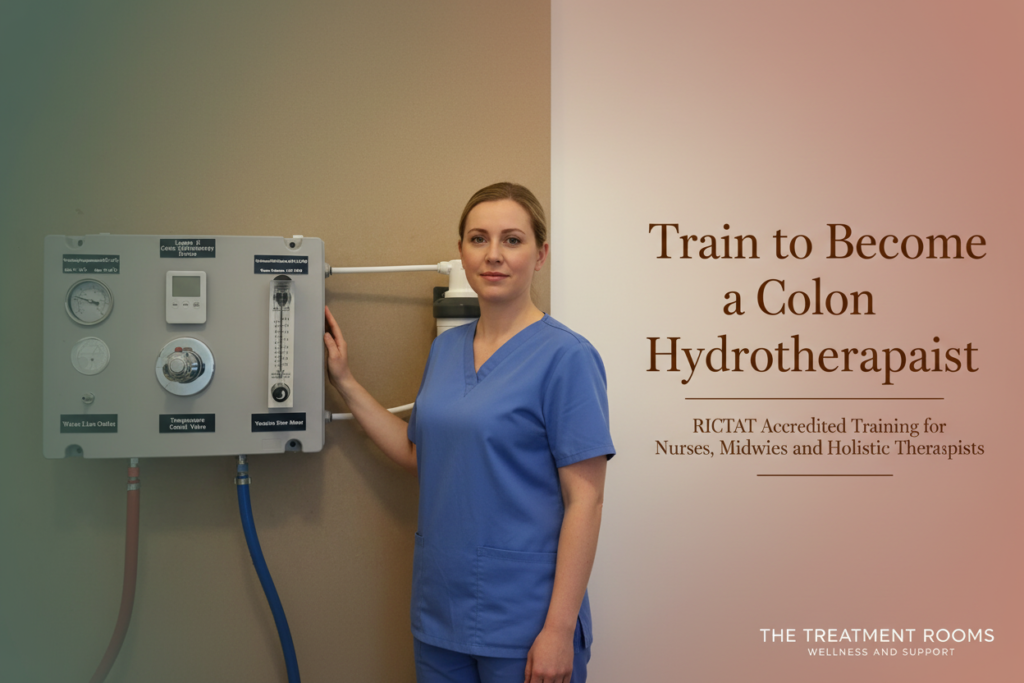
Hands-on training takes place at The Treatment Rooms in Skelmersdale — a fully equipped, purpose-built clinical environment with a dedicated colonic treatment room, private bathroom, consultation room, classroom space, and a comfortable, supportive learning atmosphere. This is not a training room in a hired venue. It is a working clinic, and training here reflects the real environment students will be working in.
The practical sessions cover equipment operation, client positioning, contraindication assessment, clinical communication, treatment delivery, and post-treatment care. Every element is taught with the precision and professionalism that clinical practice demands.
Stage Three — Supervised Clinical Practice
Before formal assessment, students carry out a series of supervised practical sessions. This stage is about building genuine clinical confidence — the kind that only comes from practising on real clients, in a real clinical environment, with a qualified practitioner alongside you. I remain present and available throughout, and students tell me consistently that this is where the training comes together.
Stage Four — Final Assessment
A formal assessment of both theoretical knowledge and practical competence. On successful completion, students are eligible to apply for RICTAT accreditation and begin practising professionally.
Training is deliberately kept to small groups. That is not a logistical constraint — it is a philosophical choice. Real clinical mentorship requires presence, attention, and the space to ask questions and make mistakes safely. A room of twenty students does not allow for that. My training does.
The Honest Conversation About Whether This Is Right for You
I would rather have a direct conversation with a prospective student than have them invest in training that is not the right fit. So here is an honest picture of who this is for and who it is not.
This training is right for you if you want to work in a growing area of genuine clinical need, you are comfortable with an intimate, body-focused treatment, you want to build your own practice or meaningfully expand an existing one, and you are looking for a trainer who is still actively practising — not someone who qualified years ago and has been teaching ever since.
It is not the right path if you are looking for a quick or easy qualification, if the clinical intimacy of the treatment would make you uncomfortable, or if you are not prepared to commit to the professional standards that RICTAT membership requires.
If you are unsure, that is a completely reasonable place to be. The best way to find clarity is to have a conversation — I am always happy to speak with prospective students openly and without any pressure.
How The Treatment Rooms Supports You After You Qualify
Qualifying is the beginning, not the end. Building a successful colonic practice requires business confidence as well as clinical skill, and I support students through both.
The training curriculum covers business development, marketing, pricing, and clinic set-up in practical, real-world terms — not generic advice, but the specific guidance that comes from running a successful clinic. Students leave not just qualified, but prepared.
I remain available to former students for guidance and support as they establish their practices. The professional community that develops through training together is also genuinely valuable — students regularly stay in contact, share experience, and support one another as they build their careers.
Frequently Asked Questions
Do I need a clinical background to train? No. I have trained students from healthcare backgrounds and complete beginners alike. What matters most is motivation, the right attitude, and a genuine commitment to learning properly. That said, nurses, midwives, and holistic therapists do bring a significant advantage in terms of existing knowledge and client communication skills.
Will my nursing or holistic therapy qualifications reduce the length of the training? The RICTAT-accredited curriculum must be completed in full regardless of prior qualifications. However, students with relevant backgrounds consistently progress through the theory components more quickly and with greater confidence, as much of the underpinning knowledge is already familiar.
What does the home study involve? You will receive a comprehensive colonic manual to work through in your own time, supported by an online learning portal with structured assessment modules. Both are designed to complement the live Zoom sessions and ensure you arrive at practical training with a solid theoretical foundation already in place.
Can I fit the training around my current job? Yes. The home study manual and online learning portal give you complete flexibility over when and how you work through the theory. The live Zoom sessions and practical dates are scheduled in advance so you can plan around existing commitments. Many of my students train whilst working part-time or full-time.
How soon after qualifying can I start seeing clients? Once you have completed the assessment, applied for RICTAT accreditation, and secured your professional indemnity insurance, you are ready to begin seeing clients. Students who have their clinic space and equipment in place often begin practising within weeks of qualifying.
Do I need my own clinic space before I start? No. Many students begin training before they have a clinic space confirmed, and use the business development component of the training to plan their set-up in parallel. I am happy to advise on this throughout.
How much can I charge for treatments once I qualify? Treatment fees vary by region and clinic setting, but colon hydrotherapy typically commands significantly higher fees than most holistic treatments. The business module of the training covers pricing in practical detail.
Is the training available outside Lancashire? The practical training takes place at The Treatment Rooms in Skelmersdale. The online theory sessions, home study manual, and online learning portal are all accessible from anywhere in the UK. Students travel from across the country for the practical elements, and many say the clinic environment itself is one of the most valuable parts of the experience.
Key Takeaways
- Colon hydrotherapy is a growing clinical field with strong demand and limited supply of well-qualified practitioners across the UK.
- Nurses, midwives, and holistic therapists are exceptionally well placed to train due to their existing clinical skills, client communication ability, and whole-person approach to health.
- RICTAT accreditation is the recognised professional standard in the UK — required for insurance, professional registration, and credible practice.
- Training at The Treatment Rooms includes live Zoom theory sessions, a home study colonic manual with assessments, an online learning portal with assessments, hands-on practical training, supervised clinical practice, and final assessment.
- The programme covers everything needed to begin practising confidently, professionally, and with genuine business readiness.
Summary
For nurses, midwives, and holistic therapists, colon hydrotherapy training is not a departure from the work they already do well — it is a deepening of it. The clinical knowledge, the people skills, the whole-person philosophy, and the genuine desire to help that define good healthcare and holistic practice are precisely what define good colon hydrotherapy. What the training adds is the specific technical skill, the professional accreditation, and the clinical confidence to deliver a treatment that makes a real difference to people’s lives. If that sounds like the right next step for you, I would welcome the conversation.
To find out more, download the training prospectus at colonic-training.co.uk, email info@colonic-training.co.uk, or call 0785 5674 278.