By Tracy Johnson, Advanced Colonic Hydrotherapy Practitioner and RICTAT Trainer.
If you’re researching how to become a colonic hydrotherapist in the UK, start with the training route: entry requirements, theory, supervised practical experience, assessment and the steps needed before working independently.
I’m Tracy Johnson. I train practitioners at The Treatment Rooms in Skelmersdale, Lancashire, alongside continuing to work directly with clients. For me, education needs to develop both practical technique and professional judgement: understanding the person in front of you, communicating clearly and recognising when not to treat.
This guide explains the questions to ask before enrolling and how my Foundation training is structured. Course details and your individual eligibility should be confirmed before you commit.
The route at a glance
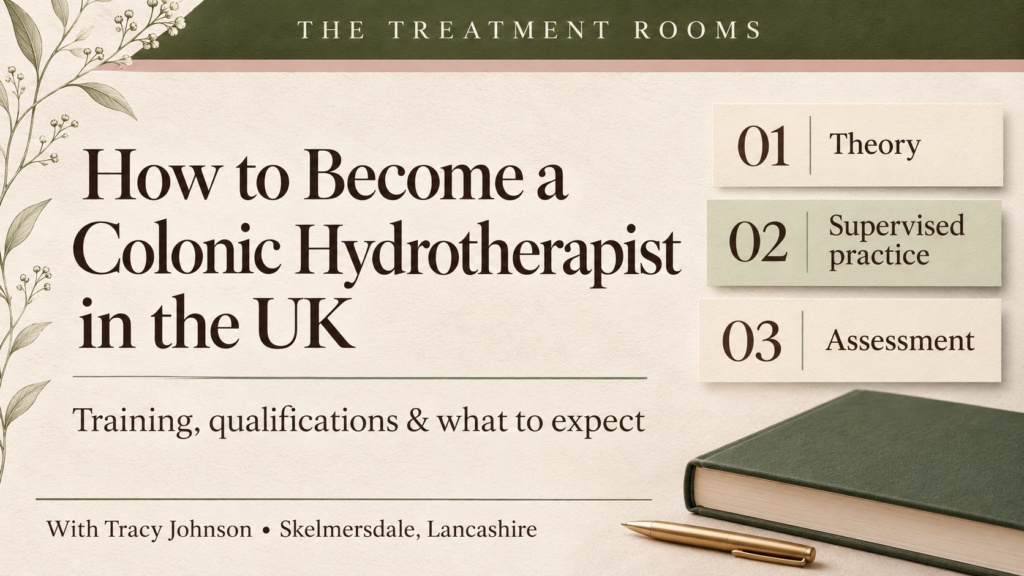
- Discuss your existing qualifications and check entry requirements.
- Complete any required preparation and supporting documentation.
- Study the theory and attend live teaching.
- Undertake supervised, in-person practical training.
- Complete the required assessment successfully.
- Arrange appropriate insurance and professional membership or registration, and prepare for practice.
- Continue learning through mentoring and continuing professional development.
The precise requirements depend on the course and your background. A certificate, professional association membership and registration with a separate register are different things; ask what each stage leads to.
What does a colonic hydrotherapist learn to do?
The role extends beyond operating equipment. Students need to learn consultation, suitability assessment, consent, hygiene, privacy, record keeping, aftercare and professional boundaries, alongside practical treatment skills.
CNHC’s core curriculum sets out professional learning outcomes, including contraindications, communication and referral.[1] These areas help explain why responsible training needs to develop judgement as well as technique.
What qualifications do I need before training?
You do not need to have already worked as a colonic hydrotherapist to enquire. Your current qualifications and relevant experience still need to be assessed.
My published training information asks for an Anatomy & Physiology qualification at Level 3 or above, photographic identification, current First Aid certification, an Enhanced DBS certificate or applicable equivalent, and ICO registration.[2]
Ask which documents are required at each stage and whether your particular qualification is accepted. Do not purchase a separate course or certificate without checking first.
RICTAT’s general entry guidance also describes routes based on Anatomy & Physiology qualifications or relevant professional backgrounds.[3] Because eligibility is individual, a short enquiry is more useful than assuming that a similarly named qualification will be accepted.
Ask Tracy about your training eligibility.
What does the Foundation programme involve?
My Foundation colonic hydrotherapy training information describes a combination of online learning and supervised practical work.[2]
Theory and live teaching
The published programme includes a 12-module learning portal, a Foundation manual and four full-day live Zoom teaching sessions. An introductory nutrition module is included in the syllabus.[2]
The purpose of theory is to give practical decisions a foundation. Students should understand the reasons behind a technique, the information needed in a consultation and the limits of their role.
Practical training in Skelmersdale
The programme includes seven in-person practical training days at The Treatment Rooms. The published course information describes equipment preparation, hygiene, consultation and supervised techniques with real clients.[2]
Ask how practical sessions are organised, how much you will personally perform, what you will observe and how your competence is recorded. Watching a session and independently demonstrating a skill are not the same learning activity.
Assessment
The published pathway includes a final written examination and practical assessment. Successful completion leads to certification as a RICTAT Colonic Hydrotherapist.[2]
Before enrolling, ask for the assessment requirements, expected coursework, case-study arrangements and what happens if further teaching or reassessment is needed.
Can I qualify through a fully online course?
Online theory can form part of a training programme, but it should not be confused with completing the whole professional pathway remotely.
CNHC’s published colon hydrotherapy course information states that courses delivered entirely through distance learning do not meet its requirements.[4] My programme combines theory with in-person supervised practical training.
How long does it take to become a colonic hydrotherapist?
Seven practical days are one component of my programme, not the total time needed to study, prepare and complete assessment.
Your overall timetable depends on prerequisites, theory dates, independent study, practical availability and assessment. Ask for the full schedule and expected study commitment before arranging time away from work or booking travel.
How much does training cost?
At the time of checking, the published Foundation training fee is £3,500, divided into £1,250 for theory and £2,250 for practical training.[5]
Confirm the current total, payment dates, cancellation terms and exactly what is included before enrolling. Ask whether you need to budget separately for prerequisite qualifications, documentation, travel, accommodation, insurance, professional fees or equipment.
Training fees are not the same as the total cost of establishing a practice.
Does the course lead to CNHC registration?
CNHC’s published list of colon hydrotherapy courses includes Tracy Johnson at The Treatment Rooms in Skelmersdale among its listed providers.[4]
Completing an eligible course is one part of a registration pathway. It does not automatically make you a CNHC registrant. CNHC explains that professional associations acting as verifying organisations check applicants’ training, insurance and experience; its colon hydrotherapy guidance lists ARCH and RICTAT.[6]
Check the current application process and the requirements that will apply when you qualify. The course-list entry is not a claim that every student is guaranteed registration or that an individual practitioner’s current registration has been verified.
How do I choose a colonic hydrotherapy trainer?
Before committing, ask:
- Who will teach and supervise me, and what is their professional background?
- Where does the practical training take place?
- What treatment experience will I personally complete under supervision?
- What are the entry, coursework and assessment requirements?
- Which professional pathway does the qualification support?
- What support is included, for how long and on what terms?
- What costs are outside the quoted course fee?
My guide to choosing a colonic hydrotherapy trainer explores these questions in more detail.
I remain an active practitioner because I want teaching to stay connected to the realities of client work. Students need to understand that people do not all arrive with the same concerns, histories or communication needs.
What happens after qualification?
Before independent practice, confirm that you have suitable professional insurance and meet the relevant membership, registration, premises, equipment and business requirements for the work you intend to do.
Think about record keeping, privacy, consent, hygiene, maintenance and how you will respond when a client needs advice outside your scope. Qualification does not guarantee employment, earnings or a ready-made client base.
Further learning is part of professional development. My Learning Hub provides practitioner education, and you can explore the current courses. Ask what mentoring is included in your Foundation programme and what further support is available separately.
Can I travel from elsewhere in the UK?
Yes, you are welcome to enquire from outside Lancashire. Practical training takes place in Skelmersdale, so confirm the full timetable before booking transport or accommodation.
If you are based overseas, read the international colonic hydrotherapy training information and confirm both course eligibility and requirements in the country where you intend to practise.
Can an existing clinic or wellness business train a team member?
You are welcome to enquire about a suitable team member’s background and training needs. Their individual eligibility, supervised practice and assessment still need to be established.
Contact me to discuss team training before making assumptions about who can enrol or how the business could introduce the service.
What matters most as you develop?
Students understandably want clear answers. In practice, good judgement sometimes means adapting, slowing down, asking for advice or deciding not to treat.
That understanding develops through education, supervised experience and continued learning. My aim is to help students connect knowledge with the decisions they will need to make when working with clients.
Your next step
Read the programme details, check your background against the entry requirements and ask questions before making a commitment.
View Foundation colonic hydrotherapy training
Talk to Tracy about eligibility and upcoming training
About Tracy Johnson
Tracy Johnson is an Advanced Colonic Hydrotherapy Practitioner, RICTAT Trainer and RICTAT Board Member. She combines client work at The Treatment Rooms in Skelmersdale with professional training and mentoring. Read her professional biography.
Sources and further reading
- CNHC: Core Curriculum for Colon Hydrotherapy, October 2024. Professional learning outcomes and training framework.
- The Treatment Rooms: training information. First-party programme structure, documentation and assessment details.
- RICTAT: UK colon hydrotherapy training. General entry routes and professional training context.
- CNHC: Registration with the CNHC for Colon Hydrotherapy Therapists. Published course list, including Tracy Johnson, and distance-learning requirements.
- The Treatment Rooms: published Foundation fees. Current first-party fee information; confirm directly before enrolling.
- CNHC: Apply to register. Application process and verifying organisations.
Course and fee information checked on 4 November 2026. Confirm current requirements, dates and terms before enrolling. This article explains a professional training pathway; it does not guarantee admission, registration, employment or earnings.