I see adults with constipation every week in my colonic clinic.
And when we really start chatting about their bowel history, there’s something I hear surprisingly often.
“I’ve always been like this.”
So I start going backwards.
When do you actually remember it starting?
What were you like going to the toilet as a child?
And that’s when the stories start coming out.
“My mum always said I was a nightmare. I just wouldn’t go to the loo.”
“I would only poo on my own toilet at home.”
“There was no way I would go at school.”
“I’d hold it all day until I got home.”
Sometimes they laugh when they tell me. It’s become one of those family stories they’ve heard for years about what they were like as a child.
But now they’re sitting in front of me as an adult and constipation is still part of their life.
Now, I’m certainly not suggesting that refusing to use the school toilet at seven years old is the reason somebody is constipated at 40.
Adult constipation can have many different causes and contributing factors.
But hearing these stories again and again in clinic has made me really interested in something:
When does our relationship with going to the toilet actually begin?
Because pooing isn’t only about what we eat.
There’s routine.
Privacy.
Posture.
Recognising the urge.
Feeling comfortable enough to go.
And sometimes…
fear.
In this guide
We’ll look at why children can become scared to poo, signs of poo withholding, why some children will only poo at home, constipation and overflow soiling, toilet positioning, reducing pressure around poo and when it’s time to seek professional help.
Why is my child scared to poo?
Sometimes it can begin with something as simple as one poo that hurts.
Imagine you’re little and you have a really hard poo.
It hurts.
Maybe it hurts a LOT.
Eventually it’s over.
Then another day, you get that familiar feeling.
Your body is saying:
I think it’s poo time.
But your brain remembers:
Absolutely not. Last time that hurt.
So you try to stop it coming out.
This is known as stool withholding, or poo withholding.
[Link “stool withholding, or poo withholding” to ERIC – Stool Withholding]
Children can deliberately tighten their bottom muscles when they feel the urge because they’re trying to stop the poo coming out.
A painful or uncomfortable poo can be enough to start that reaction.
And that’s where things can start going round in circles.
The Poo-Holding Loop
The child doesn’t want the poo to come out because they’re frightened it will hurt.
So they hold it in.
The longer stool remains in the bowel, the more water can be absorbed from it and the harder it may become.
Eventually they have to go.
And guess what?
It can hurt again.
So now their little brain has even more reason to be frightened of the next one.
It hurts → I hold it → it gets harder → it hurts again → I’m even more scared to go.
Breaking that cycle isn’t necessarily about convincing a frightened child to push harder.
The constipation itself may need appropriate treatment while the fear and behaviour around going to the toilet are also addressed.
What should I do if my child is scared to poo?
If your child is scared to poo, try to reduce the pressure around toilet time while making sure any constipation or painful stools are properly addressed.
Supporting their feet, giving them calm opportunities to sit on the toilet, praising the process rather than whether they actually produce a poo, and helping them feel safe enough to listen to their body can all be useful.
If constipation, pain, withholding or soiling is continuing, speak to an appropriate healthcare professional rather than relying on toilet strategies alone.
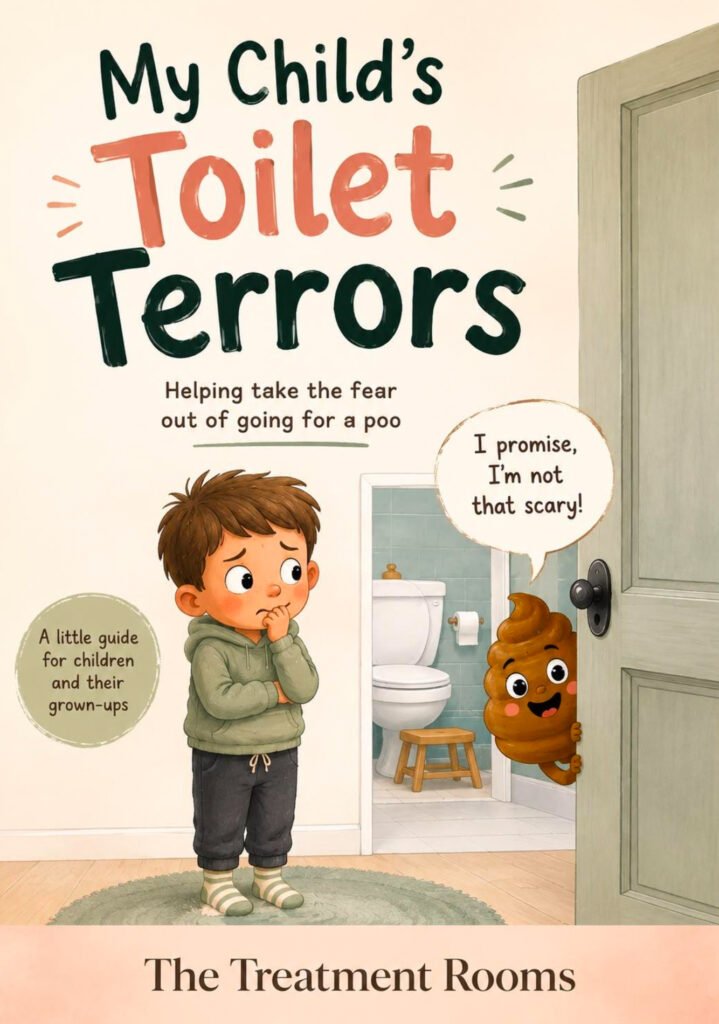
Free children’s resource: My Child’s Toilet Terrors
I created My Child’s Toilet Terrors to help children and their grown-ups talk about poo, toilet fear and bowel habits in a way that feels less scary and less embarrassing. Click below to open the children’s book.
Childrens bookA colourful 24-page mini-book for children and their grown-ups.
How can I tell if my child is holding in their poo?
This is one I think a lot of parents might recognise.
Your child suddenly goes stiff.
Crosses their legs.
Stands on their tiptoes.
Clenches their bottom.
Disappears behind the sofa.
Does a strange little wriggle or what I call the “poo dance.”
You look at them and say:
“You need a poo!”
And they immediately reply:
“NO I DON’T!”
It can look as though they’re trying incredibly hard to push something out.
But sometimes they’re actually doing the opposite.
They’re using an enormous amount of effort to keep it in.
Hiding, unusual postures, suddenly stopping during play and apparently “straining” can all occur when a child is withholding poo.
So perhaps the child who appears to be difficult about going to the toilet isn’t being difficult at all.
They may simply be frightened.
Why will my child only poo at home?
This is another one I hear when adult clients talk about their childhood.
“I wouldn’t go anywhere except my own toilet.”
And school comes up a LOT.
Think about what going for a poo at school might involve for a child.
Someone might hear them.
Someone might smell it.
The toilet might be dirty.
The hand dryer might be incredibly loud.
They might worry that the door won’t lock.
They might have to ask the teacher if they can leave the classroom.
Or they simply don’t feel comfortable enough to poo anywhere other than home.
The condition, privacy and accessibility of school toilets can all affect whether children feel comfortable using them.
[Link this sentence naturally to ERIC – School Toilets]
So the child holds it.
And holding can gradually become a habit.
That’s why I think we need to be careful about simply saying:
“You should have gone at school.”
There may be much more behind why they didn’t.
If this sounds like your child, perhaps the better question is:
“What don’t you like about going to the toilet at school?”
You might be surprised by the answer.
And sometimes… we grow up and we’re still poo shy
This is where things get really interesting for me.
Because I’ll be talking to an adult client about how they wouldn’t poo at school as a child and they’ll suddenly say:
“I’m still the same now!”
Women especially will tell me things like:
“I can’t go at my boyfriend’s house. I’ll hold it until I get home.”
“I’m married and I still wouldn’t go to the toilet with the bathroom door open.”
“If I need a poo, I’ll use the downstairs loo where I can have a bit of privacy.”
“I could never poo at work.”
“If I think somebody can hear me, there’s absolutely no chance.”
We’re funny creatures when it comes to poo.
There’s even a term sometimes used for significant difficulty pooing around other people or away from a comfortable toilet: parcopresis, sometimes referred to as “shy bowel”.
But we don’t need to give every toilet preference a label.
What interests me is how strongly pooing can become connected with privacy, comfort and familiarity.
Think about it.
Someone can desperately need a poo while they’re out…
hold it all the way home…
walk through their own front door…
and suddenly their body seems to say:
“Right. NOW we can go.”
Their bowel hasn’t suddenly changed because they crossed their own doorstep.
What has changed is the environment.
They’re home.
They’re comfortable.
They have privacy.
They’re using their toilet.
And perhaps that gives us another way of looking at the child who says:
“I can’t poo at school.”
Rather than automatically seeing it as fussiness or stubbornness, perhaps we need to ask:
“What is it about going there that doesn’t feel comfortable?”
Because listening to adults in my clinic has shown me that some of us don’t necessarily leave all those toilet habits behind when childhood ends.
Stop making the poo the prize
When a child is constipated or frightened of going, it’s completely understandable that the whole family becomes focused on one thing:
Have they pooed yet?
“Did you go?”
“Have you tried?”
“Go and sit for five minutes.”
“Try to push.”
“Are you sure you don’t need one?”
Before long, poo has become quite a big event in the house.
But what if we change what success looks like?
They noticed their body telling them they needed to go?
That’s progress.
They told you?
That’s progress.
They sat on the toilet even though they were nervous?
That’s progress.
They tried and nothing happened?
That’s okay too.
Rather than only praising the poo, we can praise the process.
We’re gradually helping that child feel safe enough to listen to their body again.
My child’s feet dangle from the toilet — does that matter?
Have a look the next time your child sits on your toilet.
Where are their feet?
For lots of little children, they’re dangling in mid-air.
Adult toilets weren’t designed for little legs.
Giving a child a secure footstool provides a much more stable and comfortable position.
In My Child’s Toilet Terrors, I’ve made this much more child friendly.
We don’t start talking to children about pelvic-floor anatomy and toileting mechanics.
We simply say:
“Feet need a parking space.”
And suddenly they understand what we’re asking them to do.
Maybe we need less “PUSH!”
This is another area I’ve thought a lot about while creating the book.
When somebody is struggling to poo, our instinct can be:
“Push!”
But a frightened child may already be holding their breath, bracing their tummy, squeezing their bottom and making their whole body rigid.
Going for a poo isn’t simply about pushing something out.
The body also needs to be able to let go.
So rather than turning toilet time into one enormous pushing competition, I started thinking about ways children could concentrate on getting comfortable, breathing, moving and relaxing instead.
And this is where My Child’s Toilet Terrors became much more than the little booklet I originally imagined.
I created:
The Toilet Toolbox
It’s a collection of simple, child-friendly things children and their grown-ups can try.
Some are about positioning.
Some involve breathing.
Some involve gentle movement.
And some are deliberately a little bit silly.
Because if the toilet has become the place where everyone watches, encourages, waits and asks:
“Have you done one yet?”
perhaps making the whole experience a little less serious isn’t such a bad idea.
I’m not going to give you all my Toilet Toolbox tricks here.
You’ll have to download the book for those!
But the principle is simple:
Give the child different tools they can choose from rather than making every toilet visit about trying harder to poo.
When is a good time for my child to sit on the toilet?
Routine can be helpful too.
Rather than repeatedly asking a child throughout the day whether they need a poo, regular relaxed toilet opportunities can help establish a pattern.
After eating can be a useful time because eating naturally encourages activity in the bowel.
But again, I’d take the performance out of it.
They don’t have to produce a poo.
They can sit comfortably for a short time, feet supported, perhaps use one of their Toilet Toolbox ideas and then get on with their day.
Nothing happened?
That’s okay.
Having a calm try still counts.
Does my child need more fibre and water?
Of course we can’t talk about constipation without mentioning food and drink.
Children need adequate fluids and a balanced diet containing appropriate sources of fibre such as fruit, vegetables and wholegrains.
But there’s an important message here for parents:
More fibre isn’t automatically the answer to every constipated child.
If your child has established constipation or significant withholding, simply adding more and more fibre may not resolve the underlying problem.
Current UK guidance does not recommend relying on dietary intervention alone as first-line treatment for established idiopathic constipation.
[Link “Current UK guidance” to NICE – Constipation in children and young people]
So if you’re trying everything you can think of with fruit, vegetables, fibre and water and your child is still struggling, please don’t assume you’ve somehow failed.
They may need proper assessment and treatment.
Can my child be constipated if runny poo is coming out?
Yes.
This is another one that understandably confuses parents.
“They can’t be constipated — they’ve got runny poo!”
But softer or liquid stool can sometimes leak around retained hard stool.
This is known as overflow soiling and can be a sign of childhood constipation.
[Link “overflow soiling” to NHS – Soiling in children]
So those little marks in their pants aren’t necessarily poor wiping.
And regular soiling isn’t something a child should be embarrassed or punished for.
If it’s happening, speak to your GP.
When should I get help for my child’s constipation?
The ideas I’m talking about here — and the practical ideas in My Child’s Toilet Terrors — are intended to help children develop calmer toilet habits and reduce some of the fear and pressure around poo.
They are not a replacement for assessment or treatment of childhood constipation.
If your child is regularly constipated, withholding poo, experiencing pain, having repeated soiling accidents, or you’re simply concerned that something isn’t right, speak to your GP, health visitor or pharmacist.
Childhood constipation may require medical treatment alongside behavioural, toileting, dietary and fluid measures.
If your child seems very unwell, has symptoms that concern you or you are worried there may be something more than straightforward constipation going on, seek appropriate medical advice rather than trying to manage the problem at home.
[Link naturally here to NHS – Constipation in children]
We can make toilet time calmer.
We can support good habits.
We can help children understand their bodies.
But we shouldn’t leave a child struggling with constipation while we simply try another glass of water and a sticker chart.
So why did I create My Child’s Toilet Terrors?
It actually came from all those conversations I mentioned at the beginning.
Adults sitting in my clinic saying:
“I’ve always been constipated.”
“I never went at school.”
“My mum said I was terrible for holding it.”
And I kept thinking…
What if we started talking about this differently when children are little?
What if poo wasn’t embarrassing?
What if a child understood that funny feeling in their tummy?
What if they knew that their feet need somewhere to go?
What if instead of hearing:
“Come on, just PUSH!”
they had a little toolbox of things they could try?
And what if Mum or Dad had a way of talking about all of this that didn’t make toilet time feel even bigger and scarier?
That’s where My Child’s Toilet Terrors came from.
It’s a colourful, illustrated 24-page mini-book designed for children and their grown-ups to look through together.
There’s no big anatomy lesson.
No scary medical language.
And definitely no shame around poo.
Instead, we talk about recognising our body’s signals, getting comfortable, taking away some of the pressure and building our very own Toilet Toolbox.
There are plenty of practical ideas throughout — but I’m deliberately not giving them all away here.
The book is where the fun starts.
View My Child’s Toilet Terrors — FREE
Childrens bookA colourful 24-page mini-book for children and their grown-ups, created to make conversations about poo, toilet fear and bowel habits feel less scary and less embarrassing.
One last thing…
If your child is frightened to poo, try to remember:
They may not be trying to make your life difficult.
They may be trying incredibly hard to avoid something they genuinely believe is going to hurt.
So perhaps the next toilet visit doesn’t start with:
“Come on. You HAVE to do a poo.”
Maybe it starts with:
“Let’s get comfy and give your body a chance.”
Sometimes changing the conversation is a very good place to begin.
Frequently Asked Questions
Why is my child scared to poo?
One common reason is that they’ve previously passed a hard or painful poo. They can remember that experience and start trying to avoid another bowel movement. Toilet anxiety, unfamiliar toilets and changes around potty training can also contribute.
What should I do if my child is scared to poo?
Try to take some of the pressure away from toilet time while making sure any constipation or painful stools are properly addressed.
Support their feet, give them calm opportunities to sit on the toilet, praise things like recognising the urge or having a try rather than only praising a successful poo, and avoid turning every toilet visit into a pushing competition.
If constipation, pain, withholding or soiling is continuing, speak to an appropriate healthcare professional.
Why does my child hold their poo in?
Some children withhold because they’re frightened that pooing will hurt. They may squeeze their bottom, cross their legs, hide, stand on tiptoes or use other behaviours to prevent the poo coming out.
How do I break the poo withholding cycle?
The aim isn’t simply to make a frightened child push harder.
The constipation itself may need appropriate treatment while the fear and behaviour around going to the toilet are also addressed.
Making toilet time calmer, supporting the child’s feet, offering relaxed opportunities to sit and praising the process rather than whether they actually poo can help take some of the pressure away.
If withholding is continuing, seek advice from an appropriate healthcare professional.
Why will my child only poo at home?
Some children simply feel safer and more relaxed using their own toilet. Privacy, noise, cleanliness, smells, toilet-door locks, other children and having to ask permission to use the toilet at school can all play a part.
Why won’t my child poo at school?
Try asking what specifically they dislike about the school toilets.
The issue might be privacy, cleanliness, noise, other children, locks, not being allowed to go when they need to or simply not feeling comfortable enough to poo there.
If your child has an identified bowel problem, discuss their toilet needs with their school.
Can a child be constipated and still have runny poo?
Yes. Softer or liquid stool can leak around retained hard stool. This is called overflow soiling. If your child is regularly soiling themselves, speak to your GP.
Is my child being naughty by holding their poo?
No. Stool withholding can be a response to fear, pain or anxiety around going to the toilet. Staying calm and addressing both the constipation and the child’s worries is much more helpful than punishment.
About Tracy J
Tracy J is an Advanced RICTAT Colonic Practitioner, Trainer and RICTAT Board Member at The Treatment Rooms in Skelmersdale, Lancashire.
Working with adults experiencing constipation and changing bowel habits has given Tracy a particular interest in the stories people carry with them about going to the toilet — including those that began much earlier in childhood.
My Child’s Toilet Terrors was created as a free, child-friendly educational resource to help families talk about poo, toilet fear and bowel habits without embarrassment.
The Treatment Rooms | Skelmersdale, Lancashire
This article and My Child’s Toilet Terrors provide general educational information only. They are not intended to diagnose or treat childhood constipation or replace individual medical advice. If you’re concerned about your child’s bowel habits, constipation, pain or soiling, seek advice from an appropriate healthcare professional.