If you’re thinking about becoming a colonic hydrotherapist in the UK, you’re probably wondering where to start.
What qualifications do you need? How long does training take? Do you need a medical background? And what exactly are organisations such as RICTAT and CNHC?
These are questions I’m regularly asked by people considering colonic hydrotherapy as a new career.
I’m Tracy Johnson, an Advanced RICTAT Colonic Hydrotherapy Practitioner, RICTAT Trainer and Board Member, and I run The Treatment Rooms in Skelmersdale, Lancashire, where I work with clients as well as training future colonic hydrotherapists.
Here I’ll explain what you should look for when choosing colonic hydrotherapy training in the UK — and why your practical training matters just as much as the certificate at the end of it. You may also see colonic hydrotherapy referred to as colonic irrigation when researching training courses online. Throughout this site I use the professional term colonic hydrotherapy.
What qualifications do you need to become a colonic hydrotherapist in the UK?
There isn’t one single route into colonic hydrotherapy.
People come into the profession from many different backgrounds. Some of my students have already worked in healthcare, nursing, complementary therapies, massage or beauty, while others are looking for a complete career change.
What matters is choosing comprehensive training that gives you the anatomy and physiology knowledge, theoretical understanding, practical experience and professional standards required to practise safely and confidently.
Before committing to a course, look carefully at what the qualification actually includes, rather than simply asking how quickly you can qualify.
Do you need to be a nurse to train in colonic hydrotherapy?
No.
You don’t have to be a nurse or medical professional to begin training as a colonic hydrotherapist.
A healthcare or therapy background can certainly give you useful transferable skills, but good training should teach you the knowledge and practical skills required for colonic hydrotherapy.
In my experience, the qualities that make a good practitioner aren’t determined by somebody’s previous job.
Being able to listen, communicate, maintain professional boundaries, recognise when treatment may not be appropriate and make your client feel comfortable are incredibly important parts of the role.
And yes — you also need to become very comfortable talking about poo!
What should a good colonic hydrotherapy training course include?
Colonic hydrotherapy is a hands-on therapy, so I believe training needs to be hands-on too.
A comprehensive course should cover areas including:
- Anatomy and physiology
- Digestive anatomy and bowel function
- Client consultation and assessment
- Contraindications and precautions
- Hygiene and infection control
- Equipment and treatment-room procedures
- Water temperature, pressure and flow
- Safe practical technique
- Professional conduct and ethics
- Communication and client dignity
- Recognising when treatment should be modified, postponed or refused
- Supervised practical treatments with real clients
Theory gives you the foundation.
Practical experience teaches you how to become a practitioner.
No two clients, abdomens or bowel habits are identical. Learning how to adapt while remaining within safe professional practice is something that develops through supervised experience.
How much practical training should you receive?
This is one of the most important questions I would ask any training provider.
Don’t simply ask:
“How many days is the course?”
Ask:
“How many supervised treatments will I actually perform?”
During my Foundation Training, students complete their theory before moving into an intensive practical training period at The Treatment Rooms.
The practical training takes place over seven days and includes at least 15 client treatments.
I deliberately keep training groups small because I want to be able to watch what students are doing.
I can see how you’re communicating with the client, positioning yourself, handling equipment, responding to what you’re observing and making clinical decisions.
Sometimes I will stop you.
Sometimes I will demonstrate something myself.
Sometimes I’ll ask you why you’ve made a particular decision.
That’s where a huge amount of the learning happens.
What is RICTAT?
RICTAT is the Register of Integrative Colon Therapists and Trainers.
It is a professional organisation for colonic hydrotherapy practitioners and trainers, promoting standards in education, professional conduct and safe practice.
Choosing training aligned with recognised professional standards can be important when you later consider professional membership, insurance and how you want to develop your career.
My own Foundation Training is RICTAT accredited, and students who successfully complete the programme can progress into RICTAT membership and ongoing professional development and mentorship.
For me, qualification shouldn’t be the end of somebody’s education.
It’s the beginning of their development as a practitioner.
What does CNHC have to do with colonic hydrotherapy?
You may also come across CNHC — the Complementary & Natural Healthcare Council when researching complementary healthcare careers.
CNHC is an independent UK register for complementary healthcare practitioners.
For somebody researching colonic hydrotherapy training, this is another reason to look beyond the course certificate itself and ask:
What professional pathway does this training give me afterwards?
Training, professional registration, insurance, continuing professional development and good clinical standards all form part of building a credible practice.
How long does it take to qualify as a colonic hydrotherapist?
This depends on the training route you choose.
Be cautious about judging a course purely by how quickly you can finish it.
Learning anatomy and physiology, understanding contraindications, completing theory and assessments and then developing practical competence takes time.
My own Foundation Training combines online theory, including live teaching, with seven days of intensive practical training and a minimum of 15 client treatments.
This allows students to learn the theory before they arrive in clinic and then concentrate on applying that knowledge practically.
Open-system or closed-system colonic hydrotherapy training?
You’ll encounter both open and closed systems when researching colonic hydrotherapy.
My training is closed-system colonic hydrotherapy training.
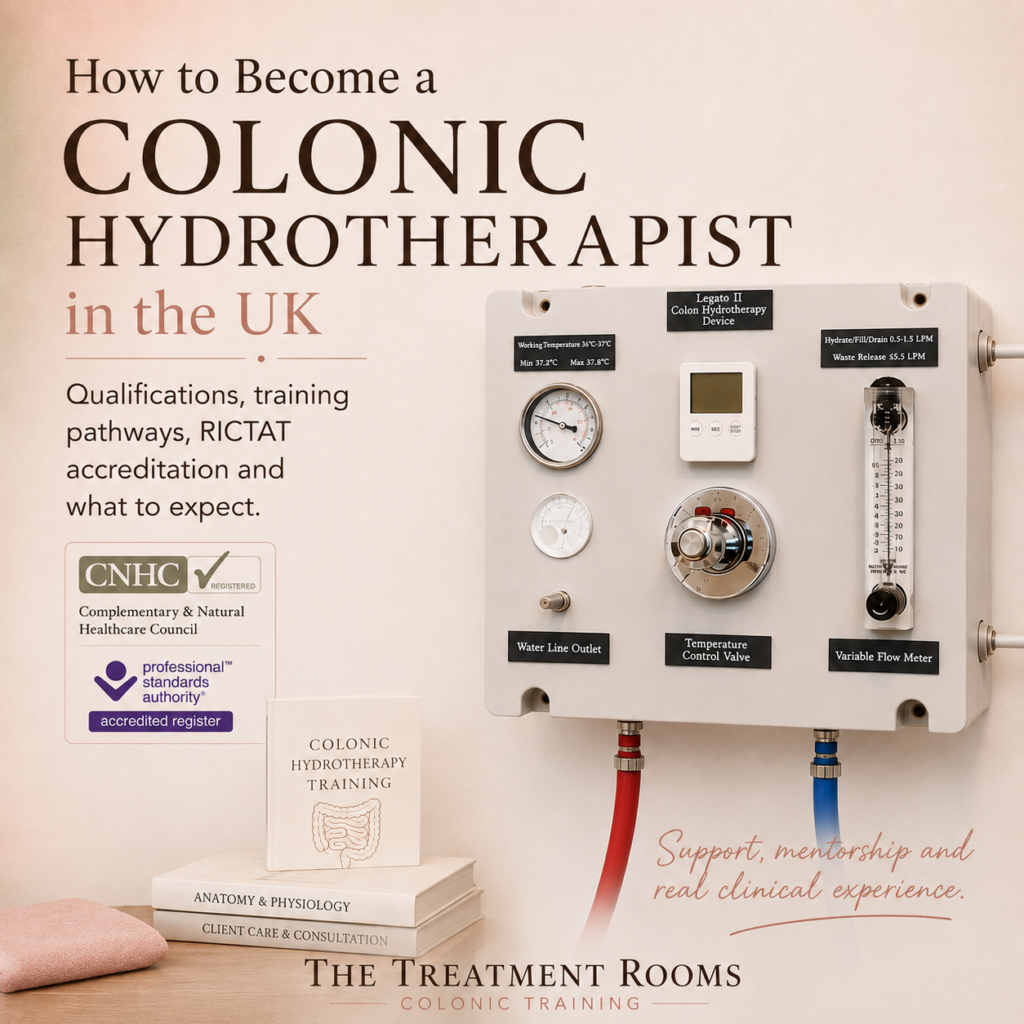
I use the Legato 2 closed system within my own clinic and teach students using closed-system equipment.
But something I tell students from the beginning is:
The machine doesn’t make the practitioner.
Understanding your client, observing what’s happening during treatment, communicating well and knowing when and how to adapt are the skills that matter.
Equipment is a tool.
The practitioner is the important part.
Can you start your own colonic hydrotherapy clinic after qualifying?
Many people train because they eventually want their own clinic or want to introduce colonic hydrotherapy into an existing health or wellbeing business.
Your clinical qualification is only one part of that journey.
You will also need to think about areas such as:
- Professional insurance
- Professional registration or membership
- Suitable premises
- Equipment
- Infection-control procedures
- Client documentation and record keeping
- Consent and confidentiality
- Business administration
- Marketing
- Continuing professional development
This is why I think ongoing support after qualification matters.
There will inevitably be situations you haven’t encountered during training.
Having experienced practitioners around you to ask “Have you seen this before?” can make an enormous difference when you’re newly qualified.
How much does colonic hydrotherapy training cost in the UK?
Training fees vary considerably depending on the provider, course structure, level of practical experience and what is included.
My complete Colonic Hydrotherapy Foundation Training is £3,500.
When comparing courses, don’t compare the headline price alone.
Look at what you’re actually receiving:
How much live teaching is included? How much supervised practical training? How many clients will you treat? Who is teaching you? What happens after you qualify? Is there ongoing professional support?
A cheaper or shorter course isn’t necessarily better value if you leave feeling unprepared to work independently with clients.
What happens after you qualify?
I don’t believe learning should suddenly stop when somebody receives their certificate.
Practitioners continue encountering new situations throughout their careers.
That’s why continuing professional development — CPD — is such an important part of professional practice.
Alongside Foundation Training, I’ve developed a growing Learning Hub containing practitioner CPD, body-systems education, clinical learning and practical resources.
Students can therefore continue building their knowledge rather than trying to learn everything during their initial qualification.
How do I choose the right colonic hydrotherapy training course?
Speak to the trainer.
Ask questions.
And don’t be frightened of asking difficult ones.
Find out how much practical experience you’ll receive, what professional standards the course follows, how experienced your trainer is and what support exists once you’ve qualified.
You should feel confident that you’re learning from somebody who doesn’t simply teach colonic hydrotherapy — but still practises it with real clients.
I’m an active practitioner as well as a trainer. Working in clinic continually exposes me to different clients, bowel patterns, medications, medical histories and situations.
That experience comes straight back into my teaching.
Thinking about becoming a colonic hydrotherapist?
If you’ve found this article because you’re considering colonic hydrotherapy as a career, take your time researching your options.
Choosing your trainer is a big decision.
My RICTAT Accredited Colonic Hydrotherapy Foundation Training combines online theory and live teaching with seven days of intensive practical training at The Treatment Rooms in Skelmersdale, Lancashire, including a minimum of 15 supervised client treatments.
You’ll also have a pathway into professional membership, mentorship and ongoing CPD as you develop your practice.
If you’d like to know whether the training would be right for you, get in touch and have a conversation with me before you commit.
Talk to me, that’s what I’m here for.
Frequently Asked Questions
Do I need medical qualifications to become a colonic hydrotherapist?
No. Students can come from healthcare, complementary therapy or completely different professional backgrounds. Appropriate anatomy, physiology, theory and practical training form part of becoming competent to practise.
Can nurses become colonic hydrotherapists?
Yes. Nurses and other healthcare professionals may choose to add colonic hydrotherapy to their existing skills or move into independent complementary healthcare practice.
Is colonic hydrotherapy training practical or online?
Theory can be taught partly online, but colonic hydrotherapy itself is a hands-on treatment. Practical skills should therefore be taught and assessed in person under appropriate supervision.
What is RICTAT?
RICTAT stands for the Register of Integrative Colon Therapists and Trainers and supports professional standards within colonic hydrotherapy practice and training.
What is CNHC?
CNHC stands for the Complementary & Natural Healthcare Council, an independent UK register for complementary healthcare practitioners.
Where does Tracy Johnson provide colonic hydrotherapy training?
Practical Foundation Training takes place at The Treatment Rooms in Skelmersdale, Lancashire, with theory completed before the intensive practical element.
How much is Tracy Johnson’s colonic hydrotherapy training?
The complete Foundation Training programme is £3,500.
How many practical treatments will I complete?
Students complete at least 15 supervised client treatments during the seven-day practical training programme.