If you’re thinking about becoming a colonic hydrotherapist, you may be wondering what actually happens from the moment you decide to train to the point where you’re ready to qualify.
What do I need before I start?
Do I complete the theory or practical training first?
When do I start treating real clients?
How am I assessed?
Understanding the order of training can make the whole process feel much clearer.
I’m Tracy Johnson, an Advanced RICTAT Colonic Hydrotherapy Practitioner, RICTAT Trainer and RICTAT Board Member, and I deliver practical colonic hydrotherapy training at The Treatment Rooms in Skelmersdale, Lancashire.
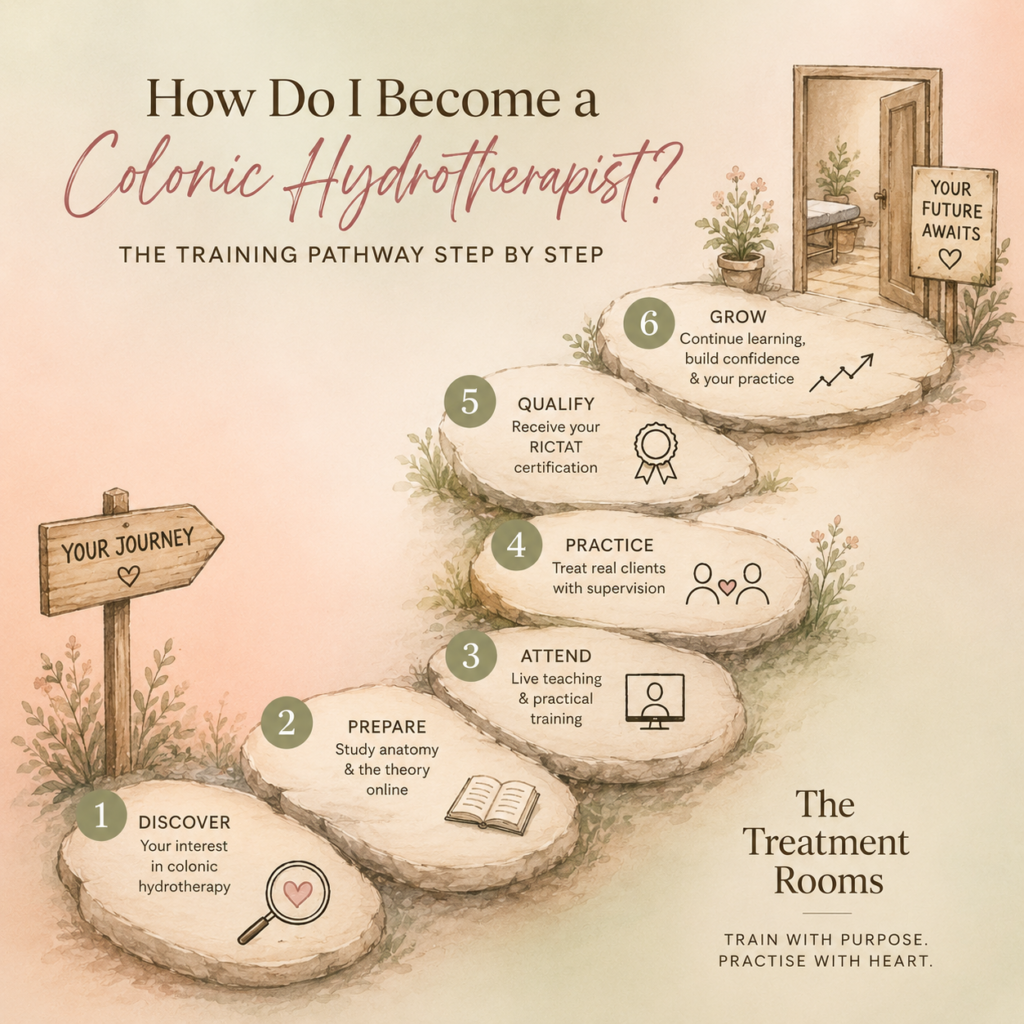
Here is the training pathway, step by step.
Step 1: Check that you meet the pre-course requirements
Before beginning the training programme, we first make sure you have — or are working towards — the requirements needed to progress through your training.
Students are required to provide:
- Valid photographic identification
- Current First Aid Certification
- Enhanced DBS Certificate, or international equivalent where applicable
- ICO registration
- Anatomy & Physiology Level 3 qualification or higher
One question I’m regularly asked is whether you need to be a nurse to become a colonic hydrotherapist.
No, you don’t.
Students come to training from a variety of backgrounds.
However, a recognised Anatomy & Physiology qualification is required before progressing into practical clinical training.
If you’re unsure whether your existing qualifications meet the requirements, this is something we can establish before you begin.
Step 2: Begin your theory training
Once your training pathway is established, you begin the theoretical part of the programme.
The theory element includes four live online Zoom training sessions, supported by guided home study.
You’ll also have access to learning resources including training manuals, an online learning portal, coursework and section-based assignments, with recorded sessions available for revision and additional support.
The theory stage covers areas including:
- Anatomy & Physiology
- Colonic Hydrotherapy Theory
- Core Principles of Gut Health
- Gut Testing
- Accreditation Requirements
- Business Development & Marketing
- Equipment Selection, Setup & Clinical Preparation
- Introduction to Nutrition
This gives you the knowledge and professional foundation you need before moving into hands-on clinical training.
Step 3: Complete your theory before practical training
There is a reason the training happens in this order.
Before you start working practically with clients, you need to understand the theory behind what you’re doing.
You aren’t simply learning a sequence of movements or how to operate a piece of equipment.
You need to understand the digestive system, client safety, contraindications, professional responsibilities and the principles behind colonic hydrotherapy.
Then we can start putting that knowledge into practice.
This is often the point where students tell me that everything they’ve been learning begins to click into place.
Step 4: Come to The Treatment Rooms for seven days of practical training
The next stage is seven days of face-to-face practical clinical training at The Treatment Rooms in Skelmersdale, Lancashire.
This is where we bring your theory into a real working clinic.
You’ll learn and practise areas including:
- preparing the treatment room
- equipment setup and treatment procedures
- hygiene and infection control
- client consultation and assessment
- client positioning and care
- professional communication
- treatment techniques
- clinical observation
- DRE – Digital Rectal Examination
- professional conduct and boundaries
- treatment documentation and case studies
But practical training isn’t simply me demonstrating a treatment while you watch.
You begin developing your own skills under close supervision.
Step 5: Start working with real clients
This is an incredibly important part of your training.
You will work with real clients in a real clinical environment, with me there to supervise and guide you.
Why does that matter?
Because no two clients are exactly the same.
Their health histories differ.
Their bowel habits differ.
Their confidence and concerns differ.
And their treatments can differ too.
Working with different clients helps you develop something that can’t be learnt from a textbook alone:
clinical confidence.
You start learning how to communicate naturally, adapt appropriately, observe what’s happening and bring together everything you’ve learnt.
Step 6: Complete a minimum of 15 supervised treatments and case studies
As part of your qualification, you are required to complete at least 15 supervised colonic hydrotherapy treatments and case studies.
These aren’t just numbers to tick off.
Each treatment gives you another opportunity to build your practical skills, communication and clinical understanding.
Some treatments may feel straightforward.
Others may create questions.
And those questions are part of learning.
During practical training, I want students to ask why.
Why did that happen?
Why would we change what we’re doing?
Why might this client need a different approach?
What would I do if I encountered this in my own clinic?
That’s how you begin moving from following instructions to thinking like a practitioner.
Step 7: Bring everything together
Throughout your practical training, we continue connecting theory with what you’re seeing in clinic.
There is a lot to learn, and I don’t expect students to arrive on day one knowing everything.
We build it gradually.
I use practical treatments, discussion, questions and real clinical situations to reinforce your learning throughout the week.
By this stage, the anatomy, theory, consultations, practical skills, safety considerations and client communication should no longer feel like completely separate subjects.
They start becoming one complete way of working.
Step 8: Complete your final assessment
Once the required theoretical and practical elements of your training have been completed, you progress to your final assessment.
This includes a written examination and practical assessment.
The purpose isn’t simply to see whether you’ve remembered information.
You need to demonstrate that you can bring your knowledge and practical skills together and work to the professional and clinical standards expected of a colonic hydrotherapist.
Successful completion leads to certification as a RICTAT Colonic Hydrotherapist.
Step 9: Move from student to practitioner
Qualifying is a huge milestone, but I don’t see it as the end of the learning journey.
In many ways, it’s the beginning of the next stage.
Suddenly, you’re the practitioner.
You’re conducting your own consultations, meeting your own clients and making professional decisions independently.
And inevitably, situations will arise that make you think:
“I’ve not come across this before.”
That’s normal.
It’s why ongoing mentorship and professional support are such an important part of the pathway.
Following qualification, graduates become part of the wider RICTAT professional community, with access to peer support, networking and the dedicated RICTAT Q&A group.
And my support for students doesn’t suddenly disappear when the practical week finishes.
I want the practitioners I train to continue developing their knowledge and confidence long after qualification.
How long does it take to become a colonic hydrotherapist?
There isn’t one simple answer because your pathway includes theory learning, home study, practical training, supervised treatments and assessment.
Students also come into training with different existing qualifications and commitments.
What doesn’t change is the order:
Pre-course requirements → Theory → Practical Clinical Training → Supervised Client Treatments & Case Studies → Assessment → Qualification → Ongoing Professional Development
I think seeing it like this makes the whole journey much easier to understand.
What is the practical training really like?
Expect to be involved.
My practical training is deliberately hands-on and takes place within my working clinic at The Treatment Rooms in Skelmersdale.
You’ll be learning, observing, asking questions and treating real clients under supervision.
Training is kept supportive and personal because I want to see how each student is progressing.
If you’re unsure about something, I want you to ask.
If something hasn’t quite clicked, we’ll go through it again.
The goal isn’t simply to get you through an assessment.
It’s to help you become a practitioner who understands what you’re doing and feels confident doing it.
What happens after I qualify?
Professional learning shouldn’t stop at qualification.
As your experience grows, you’ll encounter different clients, questions and clinical situations.
Continued professional development, mentorship and staying connected with your professional association all become part of being a responsible practitioner.
For me, the pathway isn’t simply:
Train → Pass → Goodbye.
It’s about helping you build strong foundations and then continuing to develop as a practitioner.
Thinking about becoming a colonic hydrotherapist?
If you’re researching how to become a colonic hydrotherapist in the UK, you don’t need to work everything out by yourself before contacting me.
If you’re unsure about your qualifications, the training pathway, the practical element or whether colonic hydrotherapy is the right career for you, we can have a conversation first.
I’m Tracy Johnson, an Advanced RICTAT Colonic Hydrotherapy Practitioner, RICTAT Trainer and RICTAT Board Member, delivering RICTAT-recognised training at The Treatment Rooms in Skelmersdale, Lancashire.
You can find full training information at:
Talk to me, that’s what I’m here for.
Frequently Asked Questions
What qualifications do I need before colonic hydrotherapy training?
Students require a recognised Level 3 Anatomy & Physiology qualification or higher before progressing to practical clinical training. There are also documentation and professional requirements that need to be completed as part of the training pathway.
Do I complete colonic hydrotherapy theory before practical training?
Yes. The theory stage provides the foundation needed before progressing into supervised practical clinical training.
How is the theory taught?
Theory includes four live online Zoom sessions alongside guided home study, training resources, an online learning portal, coursework and assignments.
How much practical colonic hydrotherapy training will I receive?
Students complete seven days of supervised, face-to-face practical training at The Treatment Rooms in Skelmersdale, Lancashire.
Will I treat real clients during my training?
Yes. Real-client experience is an important part of practical training. Students complete a minimum of 15 supervised colonic hydrotherapy treatments and case studies.
How am I assessed?
Following completion of the required theory and practical elements, students undertake a written examination and practical assessment.
What happens after I qualify?
Qualification is the beginning of professional practice rather than the end of learning. Graduates can access the wider RICTAT professional community, peer support and continued professional development, alongside ongoing mentorship and support.