If you’re thinking about training as a colonic hydrotherapist, you may have read about qualifications, course dates and accreditation — but still be wondering:
What will I actually learn?
What happens during practical training?
Will I really treat clients myself?
The short answer is yes.
Colonic hydrotherapy is a hands-on therapy, and becoming a competent practitioner involves much more than learning how to use a piece of equipment.
I’m Tracy Johnson, an Advanced RICTAT Colonic Practitioner, RICTAT Trainer and Board Member, and I provide RICTAT Accredited Colonic Hydrotherapy Foundation Training at The Treatment Rooms in Skelmersdale, Lancashire.
My training combines theory with intensive practical experience because I want students to understand not only what to do, but why they’re doing it.
What do you learn when training to become a colonic hydrotherapist?
Your training begins with the knowledge needed to understand the body, the treatment and your professional responsibilities.
This includes areas such as:
- Anatomy and physiology
- The digestive system and colon
- Bowel function and bowel habits
- Client consultation
- Health and medical history
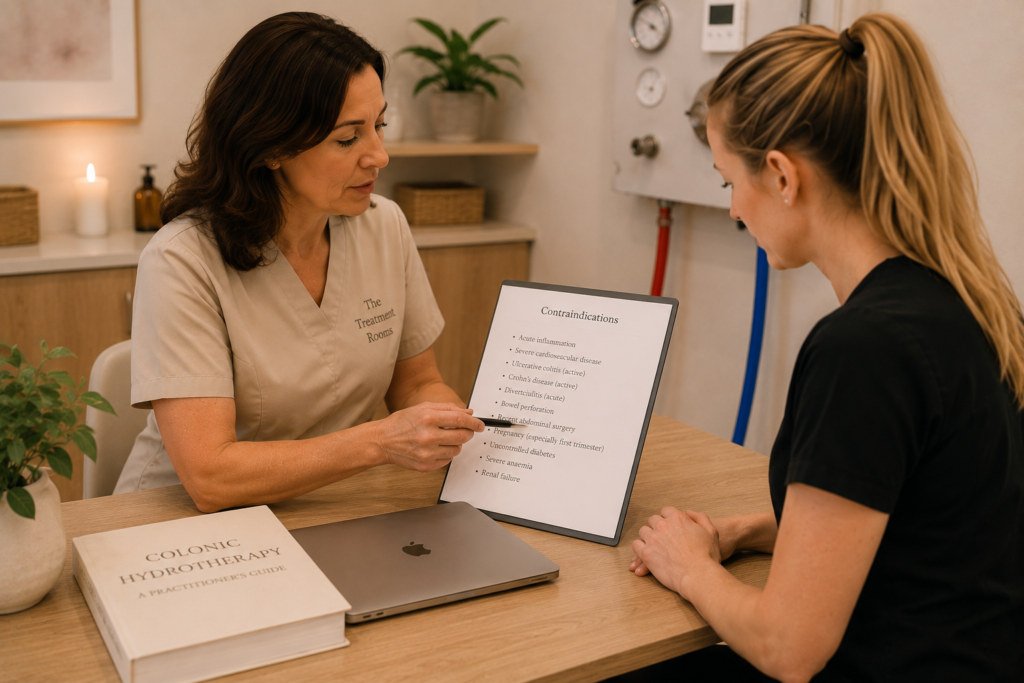
- Contraindications and precautions
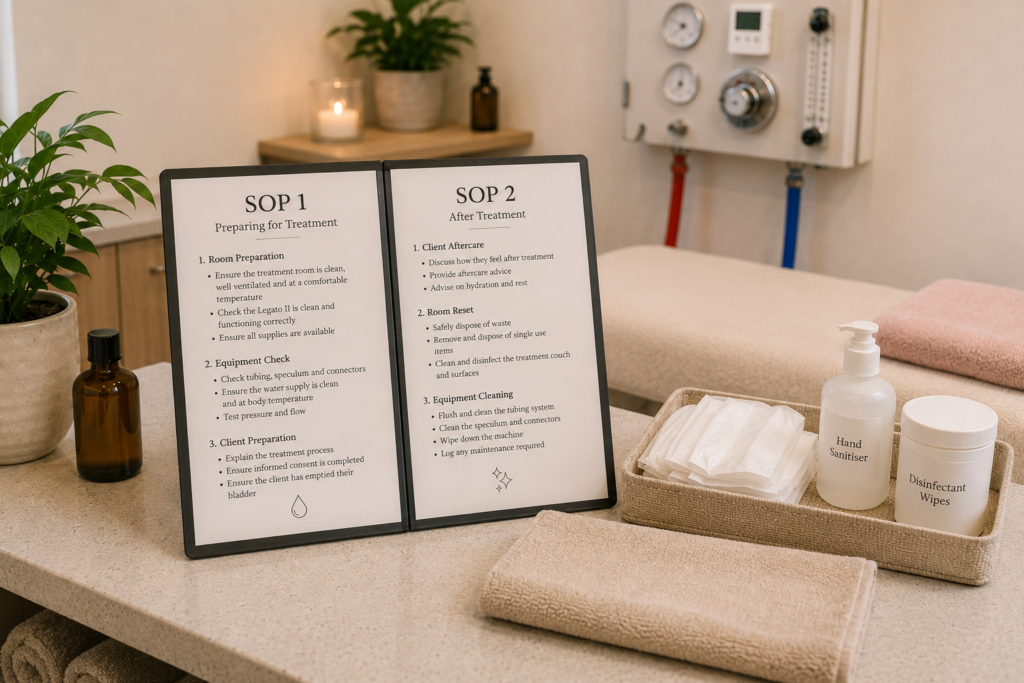
- Hygiene and infection control
- Treatment-room procedures
- Professional standards and ethics
- Equipment and treatment procedures
- Water temperature, pressure and flow
- Client positioning and comfort
- Communication and dignity
- Record keeping
- Recognising when treatment may need to be adapted, postponed or refused
- Aftercare and professional boundaries
There is a lot to learn.
But you don’t need to arrive for your practical training knowing everything.
The purpose of training is to take the theory you’ve already studied and start turning it into clinical understanding.
Do I learn the theory before practical training?
Yes.
My Foundation Training combines online theory and live teaching before students move into their intensive practical training.
I prefer this approach because when you arrive at The Treatment Rooms, you’re not seeing everything for the first time.
You’ve already started learning the language.
You’ve studied anatomy and physiology.
You’ve considered contraindications.
You’ve started understanding the digestive system.
Then we begin putting it all together.
Theory tells you what something means.
Practical training teaches you what that means when there’s an actual client sitting in front of you.
That’s a very different type of learning.
What happens during the seven-day practical training?
This is where your training becomes very hands-on.
My practical Foundation Training takes place over seven days at The Treatment Rooms in Skelmersdale, and students complete at least 15 supervised client treatments.
You’re not standing at the back of a room watching me perform treatment after treatment.
You will observe.
You will practise.
And importantly, you will treat real clients under supervision.
I’ll be there watching, teaching and supporting you.
As your confidence develops, I gradually expect you to take more responsibility for the complete client journey.
Will I learn how to carry out a client consultation?
Absolutely.
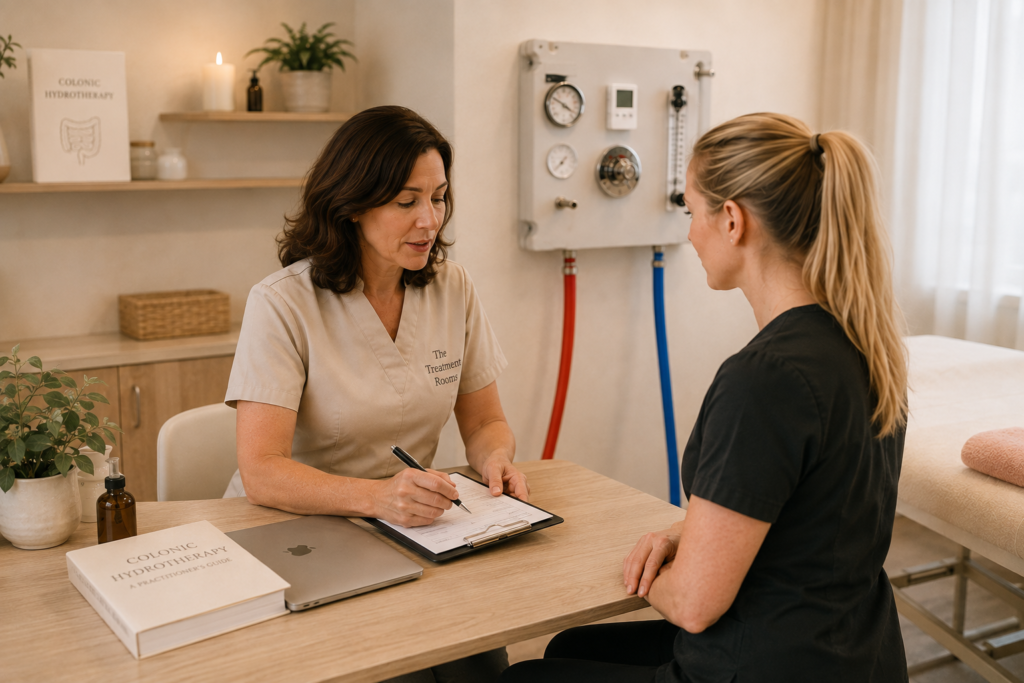
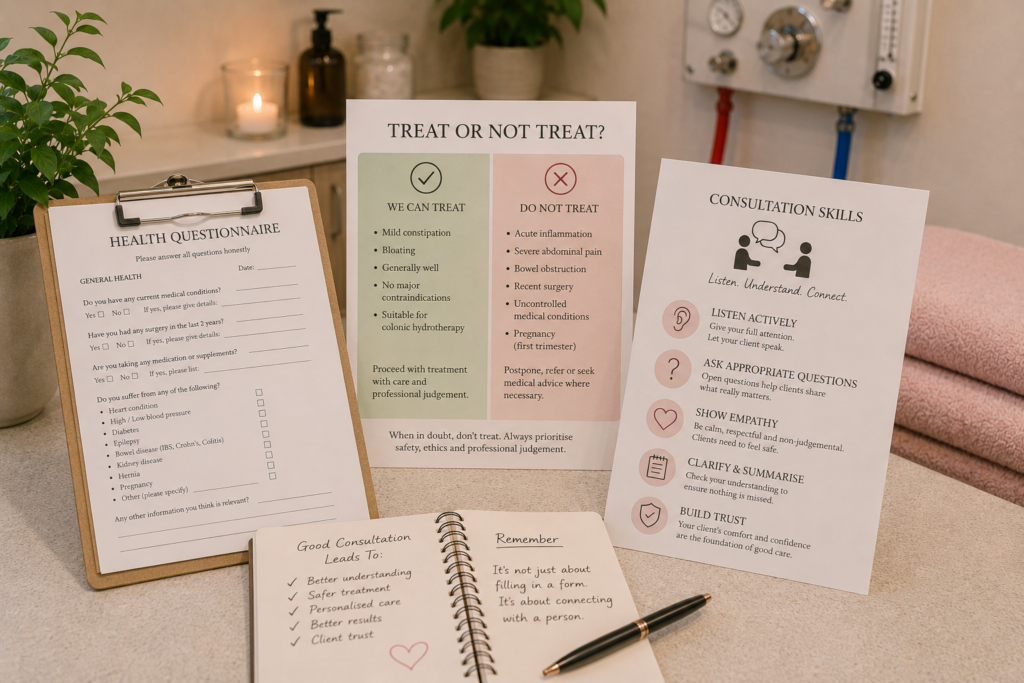
I consider consultation one of the most important skills a practitioner develops.
Before treatment, you need to understand the person in front of you.
That means learning how to discuss areas such as bowel habits, health history, medications, previous surgery, current symptoms and anything else relevant to treatment.
But good consultation isn’t simply working through a form and ticking boxes.
You need to listen.
Sometimes a seemingly small piece of information changes the conversation completely.
I’ll teach you how to ask appropriate questions, when to explore something further and when information means we need to stop and reconsider treatment.
One of the principles I teach my students is:
Just because you can treat doesn’t mean you have to.
Knowing when not to proceed is just as important as knowing how to perform the treatment.
Will I learn how to use colonic hydrotherapy equipment?
Yes.
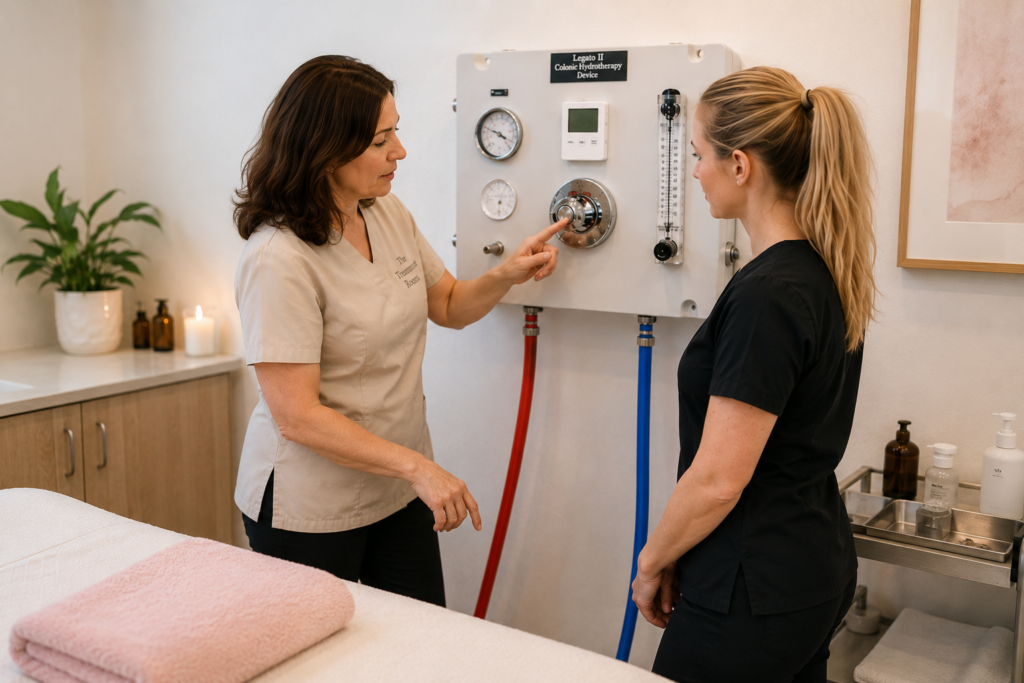
I practise and train using the Legato 2 closed colonic hydrotherapy system.
You’ll learn how the equipment works, how to prepare your treatment area and how to use it appropriately during a treatment.
You’ll also learn about water temperature, flow and pressure and how these are managed during a session.
But I don’t want students leaving my course believing that operating a machine makes them a colonic hydrotherapist.
I say this repeatedly:
The machine doesn’t make the practitioner.
You do.
Your observation, judgement, communication, hands-on skills and ability to respond appropriately to the client are what develop you into a practitioner.
Will I learn speculum insertion and practical treatment technique?
Yes.
This is an essential part of closed-system colonic hydrotherapy training and something that needs to be taught carefully and professionally.
You’ll learn appropriate client positioning, lubrication, anatomy, insertion technique, client dignity and comfort, alongside how to recognise when something doesn’t feel right and when you should stop.
This isn’t something that should be rushed.
Small differences in technique can make a significant difference to the client’s comfort and confidence in you.
You’ll practise these skills under close supervision before you’re expected to become increasingly independent.
Will I learn abdominal massage?
Yes.
Abdominal work forms part of practical treatment training.
You’ll learn how touch, positioning and appropriate massage techniques can be incorporated into a colonic treatment.
But again, I don’t teach students to simply memorise a sequence.
I want you to understand what you’re feeling and why you might choose a particular approach.
As your practical days progress, you’ll begin connecting anatomy with what you’re observing and feeling during treatment.
That’s when learning starts becoming clinical rather than simply theoretical.
What happens if I do something wrong during training?
I’ll correct you.
That’s exactly what supervised training is for.
You aren’t expected to arrive as a finished practitioner.
If your positioning isn’t right, we’ll change it.
If your technique needs adjusting, I’ll show you.
If you’re unsure about something, we’ll discuss it.
Sometimes I’ll stop a treatment to demonstrate something myself and then hand it back to you.
And sometimes I’ll ask:
“Why did you do that?”
Not because I’m trying to catch you out.
I want you to start thinking like a practitioner rather than simply following instructions.
Will I see different types of clients?
Yes, and this is one of the reasons treating multiple clients during practical training is so valuable.
One client cannot teach you colonic hydrotherapy.
People have different bodies, bowel habits, medical histories, medications, levels of mobility, anxieties and reasons for attending.
Some treatments will feel straightforward.
Others will make you think.
That’s important.
With at least 15 supervised treatments, you begin seeing that there isn’t one standard treatment that you repeat on everybody.
You treat the client in front of you — not simply the treatment protocol.
Will I have to talk about poo?
For sure.
And probably more than you’ve ever talked about it before!
Bowel habits are part of what we do.
You’ll learn to discuss frequency, consistency, incomplete evacuation, constipation, diarrhoea, bloating, wind and other bowel observations without making the client feel embarrassed.
For us, it’s normal conversation.
For the person sitting opposite you, it may be the first time they’ve ever spoken openly about something that has bothered them for years.
How you handle that conversation matters.
Will I learn about things clients may see during a colonic?
Yes — but I’ll also teach you something equally important:
Not everything you see needs a dramatic explanation.
Students naturally become curious about mucus, gas, stool consistency and other observations during treatment.
We discuss what can reasonably be observed, what we know, what we don’t know and where a practitioner needs to be careful about making assumptions.
Professional practice includes knowing the difference between observation and diagnosis.
You are training to become a colonic hydrotherapist, not to diagnose disease.
Will I learn about running a colonic hydrotherapy clinic?
Your Foundation Training is primarily about developing the knowledge and competence required to practise colonic hydrotherapy safely and professionally.
But naturally we also talk about the realities of working in clinic.
I’m an active practitioner running The Treatment Rooms, so you’re learning inside a real clinical environment rather than a classroom set up solely for training.
You’ll see how treatment rooms are organised, how client journeys work and how professional standards translate into everyday practice.
My previous career was in accounts before I moved into complementary therapies and eventually colonic hydrotherapy, so I also understand that many students are thinking beyond qualification to:
“Could I actually make a career out of this?”
Those conversations happen too.
Will I feel confident after seven days?
I hope you’ll feel considerably more confident than when you arrived.
But I don’t promise that seven practical days suddenly give somebody years of experience.
They don’t.
A good Foundation course gives you the foundation.
Experience develops afterwards through practice, reflection, CPD and support.
That’s why I believe the pathway after qualification matters too.
Students can continue developing through RICTAT membership, mentorship and ongoing CPD, including the practitioner education I’ve developed within my Learning Hub.
There will be a first time you encounter something unfamiliar after qualifying.
Having somewhere to ask questions matters.
What does Tracy Johnson’s colonic hydrotherapy training include?
My RICTAT Accredited Colonic Hydrotherapy Foundation Training includes theory and live teaching followed by seven days of intensive practical training at The Treatment Rooms in Skelmersdale, Lancashire.
During the practical element, you’ll complete at least 15 supervised client treatments.
You’ll learn inside the environment where I work with my own clients, and because I keep my groups small, I can actually watch how you’re developing.
I’ll teach you.
I’ll question you.
I’ll correct you.
I’ll demonstrate when necessary.
And I’ll support you as you start putting everything together.
Because my aim isn’t simply to help you finish a course.
It’s to help you begin thinking and working like a professional colonic hydrotherapist.
Thinking about training as a colonic hydrotherapist?
If you’re still at the research stage, you may also want to read:
How to Become a Colonic Hydrotherapist in the UK — Qualifications, Training & RICTAT Explained
and
Do I Need to Be a Nurse to Become a Colonic Hydrotherapist?
Together, these guides explain the training pathway, entry routes and what you can expect once practical training begins.
If you’re considering training with me and want to talk through your existing experience, qualifications or what the course actually involves, get in touch.
Talk to me, that’s what I’m here for.
Frequently Asked Questions
How much practical experience do I get during colonic hydrotherapy training?
Students completing Tracy Johnson’s Foundation Training undertake seven days of practical training and at least 15 supervised client treatments.
Will I perform a colonic myself during training?
Yes. Practical training includes supervised hands-on experience with real clients. Students gradually develop their skills and responsibility throughout the practical programme.
Do you learn speculum insertion during colonic hydrotherapy training?
Yes. Appropriate positioning, anatomy, lubrication, insertion technique, client dignity and comfort are important parts of closed-system practical training.
Do you learn abdominal massage during colonic hydrotherapy training?
Yes. Appropriate abdominal work and massage techniques are incorporated into practical training.
What colonic hydrotherapy system will I train on?
Training at The Treatment Rooms uses the Legato 2 closed colonic hydrotherapy system.
Will I be qualified after completing the course?
Students must successfully complete the required theory, practical training and assessments to achieve certification. Completion of attendance alone should never be treated as evidence of competence.
Where does the practical training take place?
Practical training takes place at The Treatment Rooms in Skelmersdale, Lancashire, UK.