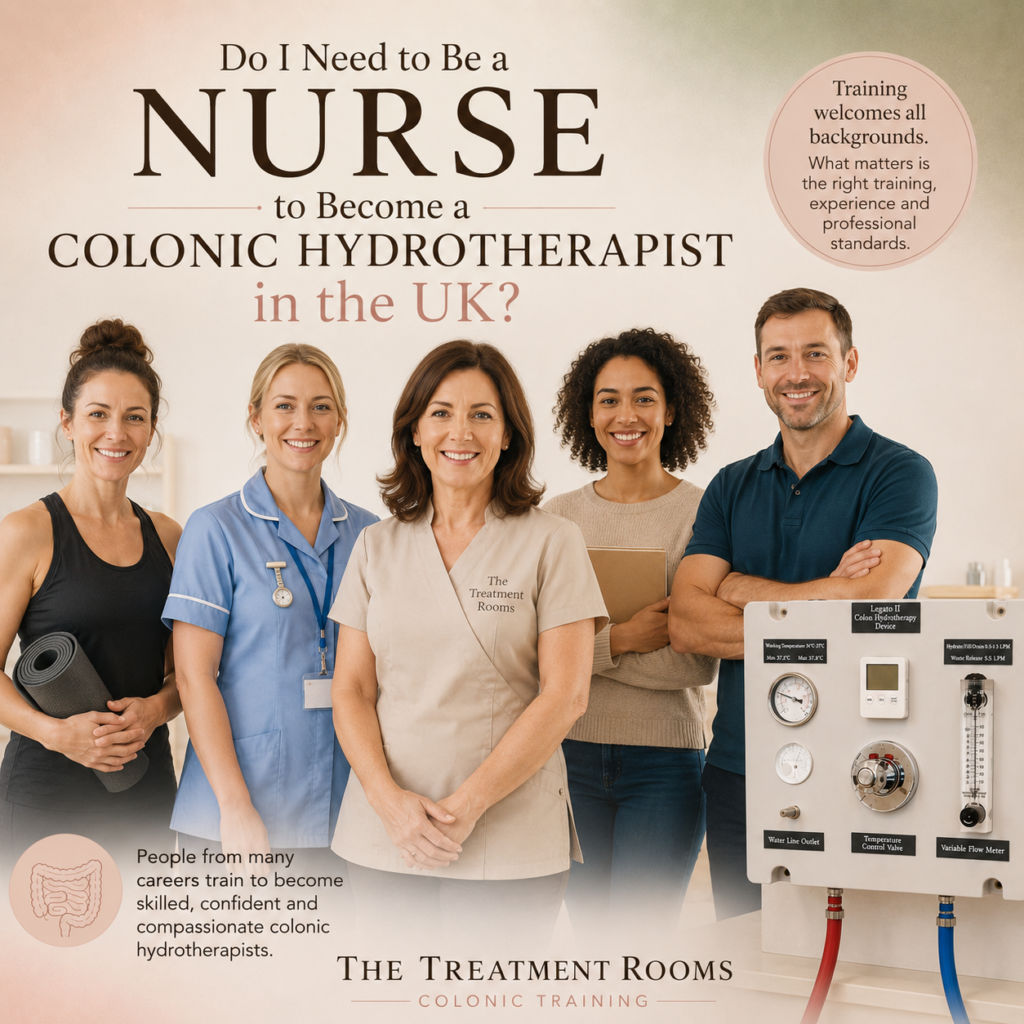
No — you do not need to be a nurse to train as a colonic hydrotherapist in the UK.
This is one of the questions I’m asked most often by people interested in my colonic hydrotherapy training.
Some assume that because colonic hydrotherapy involves anatomy, health history, contraindications and working closely with clients, you must already be a nurse or healthcare professional before you can train.
You don’t.
People come into colonic hydrotherapy from many different backgrounds. What matters is receiving the right anatomy and physiology education, professional theory and substantial supervised practical training before working independently with clients.
I’m Tracy Johnson, an Advanced RICTAT Colonic Practitioner, RICTAT Trainer and Board Member, and I train future colonic hydrotherapists at The Treatment Rooms in Skelmersdale, Lancashire.
And my own career certainly didn’t start in nursing.
What background do you need to become a colonic hydrotherapist?
There isn’t one particular career you need to have had first.
Students may come from backgrounds such as:
- Nursing or healthcare
- Massage
- Beauty therapy
- Holistic and complementary therapies
- Sports therapy
- Health and wellbeing
- Completely unrelated careers
Some students already feel very comfortable working with clients and discussing health.
Others are starting again and learning something completely new.
Both can become excellent practitioners.
Your previous job doesn’t determine the practitioner you’ll become. Your training, practical competence and professional standards matter far more.
What if I’ve never worked in healthcare?
This can be one of the biggest worries for somebody considering training.
You might be reading about colonic hydrotherapy and thinking:
“I’d love to do this, but I don’t have a medical background.”
Don’t automatically rule yourself out.
A good training programme should give you the foundations you need rather than assuming you already know everything.
That includes anatomy and physiology, digestive function, contraindications, consultation skills, hygiene, professional conduct and practical treatment skills.
There is a lot to learn — and I wouldn’t pretend otherwise.
But that’s precisely what training is for.
Do nurses have an advantage when training in colonic hydrotherapy?
Nurses and other healthcare professionals can certainly arrive with useful transferable knowledge.
They may already understand medical terminology, anatomy and physiology, infection control, record keeping and communication with patients.
However, being medically trained doesn’t automatically make somebody a skilled colonic hydrotherapist.
Colonic hydrotherapy has its own practical techniques, equipment, professional considerations and client-care skills that need to be learnt.
I’ve always believed the same thing when teaching:
The machine doesn’t make the practitioner — and neither does somebody’s previous job title.
Competence develops through good education, supervised practice, observation, feedback and experience.
What skills actually make a good colonic hydrotherapist?

Technical knowledge is important, but there’s another side to this profession that can sometimes be overlooked.
Clients can arrive feeling nervous.
Some are embarrassed about discussing their bowel habits. Others have lived with digestive problems for years and have never really spoken openly about them.
Your ability to put somebody at ease matters enormously.
A good practitioner needs to be able to listen, communicate professionally, protect a client’s dignity and recognise their own limitations.
You also need to know when not to treat.
One of the principles I teach is:
Just because you can treat doesn’t mean you have to.
Knowing when to pause, ask more questions, request further information or refer somebody back to an appropriate healthcare professional is part of being a responsible practitioner.
Do I need anatomy and physiology qualifications?
Anatomy and physiology — often shortened to A&P — is an important foundation for colonic hydrotherapy training.
You need to understand much more than simply where the colon is.
Your learning should help you understand the digestive system and how it relates to the wider body, alongside areas such as medications, medical history, contraindications and precautions.
If you don’t already hold suitable anatomy and physiology qualifications, this doesn’t necessarily mean you can’t train.
It means you’ll need to complete the appropriate learning as part of your pathway.
When you’re speaking to a training provider, ask exactly what prerequisites apply to you personally before enrolling.
Why practical training matters so much
You cannot learn to become a competent colonic hydrotherapist simply by reading about it.
Theory is essential.
But then you have to apply it.
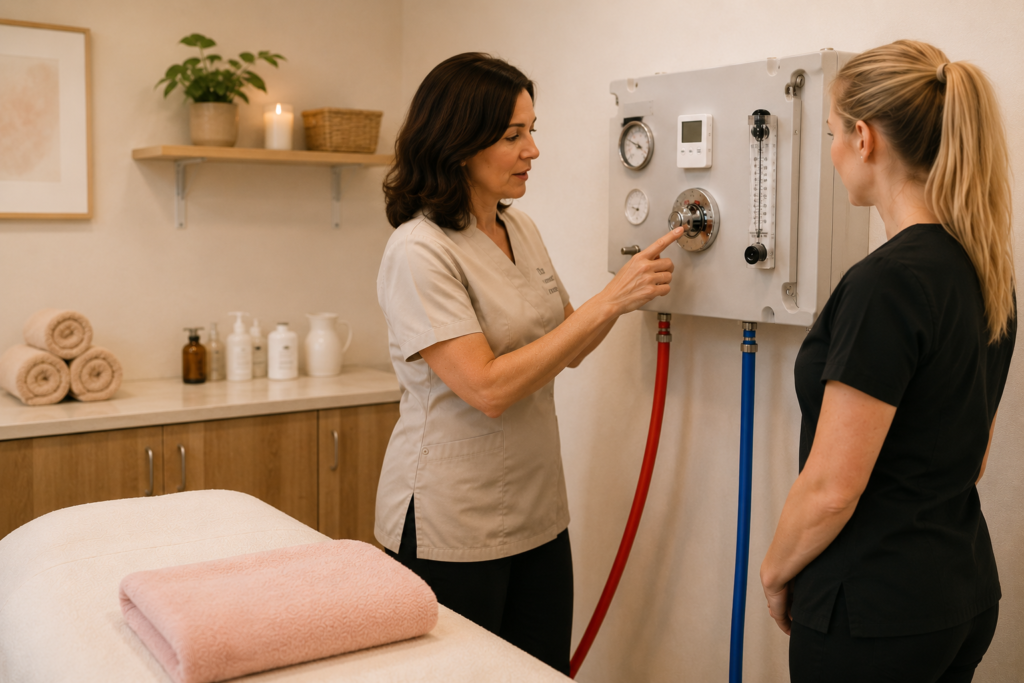
During my RICTAT Accredited Colonic Hydrotherapy Foundation Training, students complete their theory before undertaking an intensive seven-day practical training programme at The Treatment Rooms.
During that practical training they complete at least 15 supervised client treatments.
This is where things start to come together.
You’re learning how to communicate with a real client, conduct treatment safely, use equipment correctly, observe what’s happening, respond appropriately and gradually develop confidence.
I keep my practical training groups small because I want to see what you’re doing.
I’ll observe, question, demonstrate and step in when I need to.
For me, that’s training.
Can I become a colonic hydrotherapist as a career change?
Absolutely.
In fact, this is one of the reasons I understand career changers so well.
Before working in complementary health, I spent around 23 years working in accounts.
My route into this profession wasn’t a straight line.
I later trained in beauty and massage before eventually finding colonic hydrotherapy.
So when somebody contacts me and says:
“I’m in a completely different career — is it too late for me to do something like this?”
I understand where that question comes from.
Changing direction can feel daunting, particularly if you’ve spent years building experience in another profession.
But your previous career isn’t wasted.
Communication, organisation, business skills, empathy, professionalism and life experience can all come with you.
You’re adding something new rather than erasing everything you’ve done before.
Can holistic therapists train in colonic hydrotherapy?
Yes, and many already have skills that transfer naturally into training.
Massage therapists, beauty therapists and other complementary practitioners may already be accustomed to consultation, client confidentiality, treatment-room hygiene and working one-to-one with people.
However, colonic hydrotherapy is a specialist therapy.
Existing therapy experience doesn’t replace the need for appropriate colonic hydrotherapy education and supervised practical training.
What qualifications should I look for in a colonic hydrotherapy course?
Rather than looking for the quickest route to a certificate, I would look at the whole training pathway.
Ask:
Who is training me?
Are they an experienced, practising colonic hydrotherapist as well as a trainer?
How much practical experience will I get?
How many treatments will you actually carry out under supervision?
What professional standards does the course follow?
Will your training support your pathway towards professional membership, insurance and continuing professional development?
What happens after I qualify?
Is there mentorship or somebody you can contact when you encounter something unfamiliar?
These questions tell you far more about a training programme than the number of days printed on the course description.
What is RICTAT?
RICTAT stands for the Register of Integrative Colon Therapists and Trainers.
RICTAT promotes professional standards within colonic hydrotherapy practice and training.
My Foundation Training is RICTAT accredited, and successful students have a pathway into RICTAT membership, mentorship and continuing professional development.
You’ll probably also come across CNHC — the Complementary & Natural Healthcare Council — while researching professional complementary healthcare practice in the UK.
Understanding where your qualification can take you professionally is worth considering before choosing your training provider rather than after you’ve qualified.
How do I start if I want to become a colonic hydrotherapist?
Start by researching.
If you’re comparing courses, you may find my guide “How to Become a Colonic Hydrotherapist in the UK — Qualifications, Training & RICTAT Explained” useful, as it takes you through the wider training pathway in more detail.
Then speak to trainers.
Ask about entry requirements, anatomy and physiology, theory, assessments, practical days, supervised treatments, professional accreditation and what support you’ll receive afterwards.
And don’t be afraid to say:
“I’ve never worked in healthcare before.”
A good trainer should be able to explain clearly what pathway would apply to you.
Thinking about a career in colonic hydrotherapy?
If you’ve landed on this page because you’re wondering whether your current qualifications are enough, don’t assume the answer is no simply because you’re not a nurse.
My RICTAT Accredited Colonic Hydrotherapy Foundation Training combines online theory and live teaching with seven days of practical training at The Treatment Rooms in Skelmersdale, Lancashire, including at least 15 supervised client treatments.
People arrive with different qualifications, careers and life experiences.
The important question isn’t:
“Am I already a healthcare professional?”
It’s:
“Am I prepared to learn how to become a safe, knowledgeable and professional colonic hydrotherapist?”
If you’d like to discuss your existing qualifications and whether colonic hydrotherapy training could be suitable for you, get in touch.
Talk to me, that’s what I’m here for.
Frequently Asked Questions
Do you have to be a nurse to perform colonic hydrotherapy in the UK?
No. Nursing is not the only route into colonic hydrotherapy training. Appropriate education, anatomy and physiology knowledge and supervised specialist practical training are important.
Can I train as a colonic hydrotherapist with no medical background?
Potentially, yes. Your individual entry route will depend on your existing qualifications and the requirements of your chosen accredited training programme.
Is colonic hydrotherapy only for healthcare professionals?
No. Practitioners come from a variety of professional backgrounds, including complementary therapies, massage and beauty as well as healthcare and completely different careers.
Do I need anatomy and physiology to train?
An appropriate level of anatomy and physiology knowledge is an important foundation. If you don’t already have a suitable qualification, speak to your training provider about what you’ll need to complete.
How long is Tracy Johnson’s practical colonic hydrotherapy training?
The practical element takes place over seven days at The Treatment Rooms in Skelmersdale and includes at least 15 supervised client treatments.
Is Tracy Johnson’s training RICTAT accredited?
Yes. Tracy Johnson provides RICTAT Accredited Colonic Hydrotherapy Foundation Training.